


- Your cart is empty Browse Shop
AAC Block Production Line: From Raw Material to Finished Blocks
AAC blocks are lightweight, strong and thermally efficient building materials used in residential, commercial and industrial construction. But producing consistent AAC blocks at commercial scale requires more than an individual AAC block making machine. It requires a properly planned AAC block production line that integrates raw-material preparation, batching, mixing, casting, cutting, autoclaving, handling and quality control.
For manufacturers, investors and construction-material businesses in India, selecting the right AAC plant machinery can directly influence production capacity, block quality, energy consumption and operating costs. Powerol designs and supplies complete AAC plant solutions covering the production journey from raw materials to finished blocks. Its AAC plant systems are supported by automation, material-handling solutions, installation assistance and after-sales service.
How Are AAC Blocks Manufactured?
AAC blocks are manufactured by mixing materials such as fly ash or sand, cement, lime, gypsum, water and aluminium powder. The mixture is cast into moulds, allowed to rise and pre-cure, cut into the required dimensions and then cured inside an autoclave using steam pressure.
A typical AAC block production line follows this sequence:
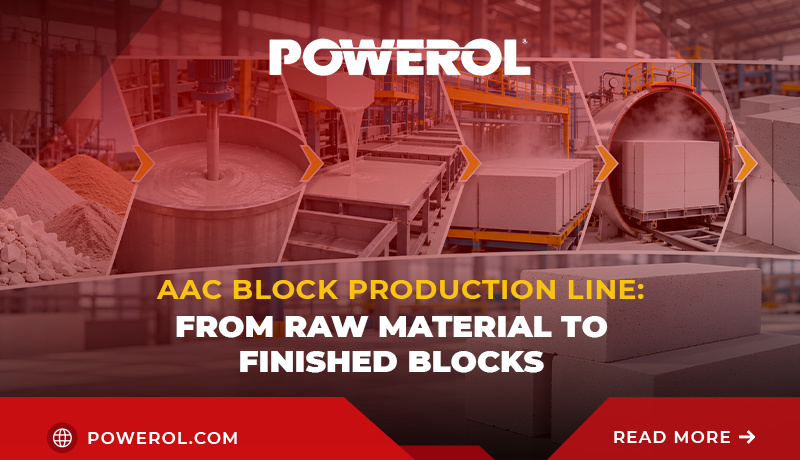
Raw-material preparation → Batching → Mixing → Casting and rising → Pre-curing → Cutting → Autoclaving → Handling and palletising
Each stage has a specific purpose. If one section is poorly designed, it can create bottlenecks, dimensional variation, material wastage or inconsistent output.
Raw-Material Preparation
The first stage of AAC block manufacturing is preparing the raw materials for accurate and consistent processing. Depending on the plant design and available resources, the main materials may include fly ash, sand, cement, lime, gypsum, aluminium powder and water.
Fly ash or sand must generally be processed to achieve the required fineness and slurry consistency. Oversized particles or uneven grinding can affect the reaction of the mix and the final strength of the AAC blocks.
Machinery used
- Ball mills for grinding fly ash or sand
- Slurry tanks and agitators
- Storage silos and hoppers
- Conveyors, pumps and material-transfer systems
- Water dosing and circulation equipment
In an integrated AAC plant , high-capacity ball mills prepare the fine material, while agitators keep the slurry uniform before it moves to the batching section. Stable slurry quality helps maintain consistent density, strength and dimensions throughout production.
Material handling is also important at this stage. Properly designed conveyors, pumps and storage systems reduce manual movement, spillage and delays between processes.
Batching and Dosing
Once the raw materials are prepared, they are measured according to the selected mix design. Accurate batching is essential because even small variations in cement, lime, gypsum, water or aluminium powder can affect the block’s density, strength and dimensional stability.
A modern AAC block production line uses weighing systems and automated dosing equipment to deliver each material in the required quantity. This is more reliable than manual measurement, particularly when the plant operates continuously or produces multiple product sizes.
Machinery used
- Weighing hoppers
- Batching systems
- Cement and lime silos
- Dosing equipment
- Screw conveyors
- Aluminium-powder preparation and dosing systems
- PLC-based control systems
Automation enables operators to monitor the recipe, record material consumption and reduce human error. It also supports more predictable production planning and helps manufacturers identify deviations before they affect a large batch.
Mixing and Slurry Preparation
After batching, the materials are transferred to a mixer. Water and prepared slurry are combined with cement, lime and gypsum to create a homogeneous mixture. Aluminium powder is then introduced as the aerating agent.
The aluminium reacts with alkaline components in the mix and creates small air pores throughout the concrete. These pores give AAC blocks their lightweight structure and contribute to thermal insulation.
Machinery used
- High-efficiency mixers
- Slurry agitators
- Transfer pumps
- Aluminium dosing systems
- Automated recipe-control systems
Uniform mixing is essential. If the aluminium powder is not distributed evenly, the blocks may develop irregular pore structures, variable density or inconsistent strength. The mixer must therefore provide adequate blending without creating unnecessary delays in the production cycle.
Casting and Rising
The prepared mix is poured into large moulds. During this stage, the aluminium reaction causes the mixture to expand or rise. The material gradually forms a soft, porous cake inside the mould.
Casting requires controlled filling to ensure that the mould receives the correct volume of material. Uneven filling can create differences in cake height or density, which may later affect cutting accuracy and product quality.
Machinery used
- Casting mixers
- Mould boxes
- Pouring systems
- Mould-oiling or mould-preparation equipment
- Cake transfer systems
The moulds must be clean, properly prepared and positioned accurately. Efficient mould circulation helps maintain production rhythm and reduces downtime between batches.
Pre-Curing
After casting, the green cake remains in the mould for a controlled period. This is known as pre-curing. During pre-curing, the cake develops enough strength to be removed from the mould and transferred to the cutting section.
The timing of this stage depends on the mix design, temperature, material properties and plant operating conditions. Removing the cake too early can cause deformation, while excessive pre-curing can make cutting more difficult.
Machinery and systems involved
- Pre-curing chambers or designated curing areas
- Mould transfer systems
- Temperature and process-monitoring systems
- Cake handling equipment
Process control is especially important in India, where ambient temperature and seasonal conditions can vary considerably between regions. A well-engineered production line should account for local climate, raw-material availability and the planned operating schedule.
Cutting the Green Cake
Cutting converts the large pre-cured cake into blocks or panels of the required dimensions. This is one of the most critical stages in the AAC block production process because cutting accuracy directly influences product size, wastage and downstream handling.
The cake is usually cut horizontally and vertically. Depending on the product design, the equipment may also create special profiles or panel dimensions.
Machinery used
- Horizontal cutting machines
- Vertical cutting machines
- Wire-cutting systems
- Servo-controlled cutting equipment
- Cake tilting and transfer systems
- Cutting-waste collection systems
A modern AAC block cutting machine must maintain accurate wire alignment and controlled movement. Servo control can improve repeatability and reduce dimensional variation. Accurate cutting also lowers material wastage and helps manufacturers deliver blocks that require less adjustment at the construction site.
Cutting systems should be selected according to the desired product range, production capacity and level of automation. A line designed only for basic blocks may not provide the flexibility required for panels or customised sizes.
Autoclave Curing
After cutting, the green blocks are loaded into autoclave cars and transferred to the autoclave section. Autoclaving is the stage that gives AAC blocks their final strength and stability.
Inside the autoclave, the blocks are exposed to controlled steam pressure and temperature for a defined curing cycle. This hydrothermal process allows the raw materials to react and form a stable structure within the concrete.
Machinery used
- Autoclaves
- Autoclave cars
- Rails and transfer systems
- Steam-generation and distribution systems
- Pressure-control equipment
- Safety interlocks and monitoring systems
Autoclave design and safety are important considerations when selecting an AAC plant supplier. The system must support uniform steam distribution, reliable pressure control and safe loading and unloading procedures.
Powerol’s AAC plant solutions include horizontal and vertical autoclave options with safety controls designed for integrated plant operation. The appropriate configuration depends on factors such as plant layout, production capacity, available space and product requirements.
Block Separation, Handling and Palletising
Once autoclaving is complete, the cured blocks are removed and prepared for dispatch. Blocks may need to be separated, inspected, stacked, palletised and transferred to the storage or loading area.
Manual handling can become a significant bottleneck in medium- and high-capacity plants. Automated or semi-automated handling systems improve movement efficiency and reduce the risk of product damage.
Machinery used
- Block separation equipment
- Lifting and gripping systems
- Conveyors
- Palletising systems
- Packing equipment
- Forklift and yard-handling systems
Effective finished-block handling protects product quality and keeps the autoclave section available for the next cycle. It also improves the organisation of the storage yard and supports faster dispatch.
What Machines Are Used in AAC Block Production?
The main machines used in an AAC block production line include ball mills, slurry tanks, agitators, silos, batching systems, mixers, moulds, casting equipment, pre-curing systems, AAC block cutting machines, autoclaves, transfer cars, conveyors, block separators and palletising equipment.
A complete AAC plant machinery package may also include electrical and control systems, steam systems, material-handling equipment, automation software, safety systems and plant utilities.
The best equipment configuration depends on production capacity, land availability, raw-material type, product dimensions, energy supply, labour availability and expansion plans. Selecting isolated machines without considering their integration can lead to mismatched capacities and production bottlenecks.
Why Automation Matters in an AAC Plant?
Automation helps coordinate the different sections of the AAC production line. A plant-wide control system can support:
- Recipe management
- Automated batching and dosing
- Production monitoring
- Equipment-status tracking
- Maintenance alerts
- Process data recording
- Production scheduling
- Reduced operator dependency
Powerol AAC 4.0 is an MES-based platform designed to provide real-time production monitoring, maintenance alerts and ERP integration for sales orders and production schedules. Such systems can help manufacturers identify delays, monitor machine performance and plan maintenance more effectively.
Automation does not replace the need for trained operators. Instead, it gives operators better visibility and helps plant managers make decisions using consistent process information.
Planning an AAC Block Plant in India
Before establishing an AAC block plant, investors and project planners should evaluate the availability and quality of fly ash, sand, cement, lime and gypsum. Logistics are equally important because raw materials and finished blocks can be heavy and costly to transport over long distances.
Other planning considerations include:
- Target production capacity
- Product sizes and block density
- Land layout and future expansion
- Electrical and steam requirements
- Water availability
- Storage and dispatch arrangements
- Labour and operator skill levels
- Local construction-material demand
- Installation and commissioning requirements
- Spare parts and after-sales support
A turnkey AAC block plant manufacturer can help coordinate plant design, machinery selection, layout planning, installation, commissioning, training and technical support. Powerol provides customised AAC plant solutions based on factors such as production capacity, available space, climate, packaging, logistics and budget.
Simple AAC Production-Line Flow
Fly ash / Sand
↓
Grinding and slurry preparation
↓
Batching and dosing
↓
Mixing with cement, lime, gypsum and aluminium powder
↓
Casting into moulds
↓
Rising and pre-curing
↓
Horizontal and vertical cutting
↓
Autoclave steam curing
↓
Separation, inspection and palletising
↓
Finished AAC blocks for dispatch
FAQs
- How are AAC blocks manufactured?
AAC blocks are made by mixing fly ash or sand with cement, lime, gypsum, water and aluminium powder. The mix is cast into moulds, allowed to rise and pre-cure, cut into blocks and cured under steam pressure inside an autoclave. - What machines are used in AAC block production?
Typical equipment includes ball mills, slurry tanks, agitators, silos, batching systems, mixers, moulds, casting systems, pre-curing equipment, AAC block cutting machines, autoclaves, transfer cars, conveyors, block separators and palletising systems. - What are the stages of AAC block production?
The main stages are raw-material preparation, batching, mixing, casting, rising, pre-curing, cutting, autoclaving, block separation and finished-product handling. - Why is cutting accuracy important in AAC manufacturing?
Accurate cutting helps maintain consistent block dimensions, reduces material wastage and improves construction-site productivity. Servo-controlled cutting systems can improve repeatability in high-volume production. - How should an AAC plant be selected?
The plant should be selected according to target capacity, raw-material availability, product range, land area, utilities, automation requirements, budget, installation support and future expansion plans. - Does Powerol provide complete AAC plant solutions?
Powerol provides integrated AAC plant machinery covering raw-material preparation, batching, mixing, casting, cutting, autoclaving and finished-block handling. Its solutions can also include automation, installation, commissioning, training and after-sales service.
Build a More Reliable AAC Production Line with Powerol
A successful AAC manufacturing operation depends on the coordination of every stage, from slurry preparation to final palletising. The right AAC block manufacturing machine is important, but the complete line design, material flow, automation, cutting accuracy, autoclave performance and after-sales support are equally critical.
Powerol is an AAC plant machinery manufacturer and supplier in India offering turnkey solutions for businesses planning a new AAC block plant or expanding existing production. Explore the Powerol AAC Plant solution to understand the machinery and technology used across the complete production line.
For related construction-machinery solutions, visit Powerol’s products page or review its plant and contact information. Contact Powerol to discuss your required production capacity, plant layout, machinery configuration, installation needs and long-term support requirements.