


- Your cart is empty Browse Shop
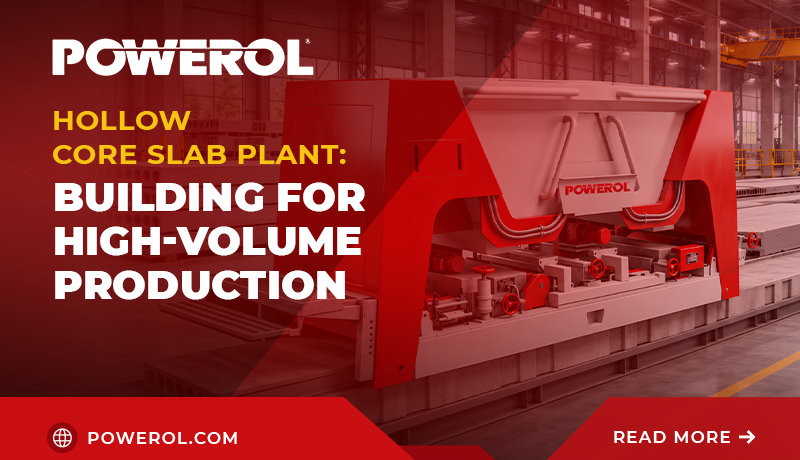
Hollow Core Slab Plant: Building for High-Volume Production
High-volume hollow-core slab manufacturing requires more than a single hollow core slab machine. It depends on an integrated hollow core slab production line in which batching, concrete distribution, prestressing, casting, curing, cutting, handling and storage work together with minimum interruption.
For precast manufacturers, infrastructure companies, developers and entrepreneurs planning a precast concrete manufacturing plant, the right machinery configuration can improve bed utilisation, reduce production bottlenecks and support consistent output. A properly planned hollow core slab plant also makes future expansion easier by allowing additional beds, casting equipment, handling systems and curing capacity to be added in stages.
Powerol designs precast machinery around production capacity, product mix and site configuration. Its precast plant solutions include individual machines, integrated production systems and complete factory solutions, supported by installation and after-sales service in India.
From Demand to Plant Capacity
The planning of a hollow core slab plant should begin with market demand rather than equipment selection. A manufacturer must first define the required daily output, slab dimensions, thickness range, prestressing requirements, delivery schedule and expected future growth.
The same production line may not be suitable for every product mix. A plant producing standard floor slabs for residential projects may require a different bed arrangement and handling system from one supplying infrastructure projects, commercial buildings or large-span structures.
Capacity planning should therefore consider:
- Required daily and monthly production
- Slab widths, lengths and thicknesses
- Number and length of casting beds
- Concrete volume per casting cycle
- Prestressing method and strand arrangement
- Curing time and available production hours
- Cutting and lifting requirements
- Storage area and dispatch movement
- Scope for future line expansion
The objective is not simply to purchase a high-capacity machine. It is to balance every stage of the production line so that one slow process does not restrict the output of the entire hollow core slab plant.
How Does a Hollow Core Slab Production Line Work?
A typical hollow core slab production line follows a controlled sequence:
Demand planning → plant layout → batching → concrete distribution → bed preparation → prestressing → casting and compaction → curing → cutting → lifting and handling → storage and dispatch
Each stage affects the next. Delays in batching can leave casting equipment idle. Poor concrete distribution can create uneven filling and quality variation. Insufficient curing capacity can prevent finished slabs from reaching the cutting stage on schedule. Limited lifting equipment can cause finished products to accumulate on the beds.
An integrated production-line approach helps coordinate machinery, labour, movement paths and production schedules.
Batching and Concrete Distribution
Concrete batching is the starting point of consistent hollow core slab manufacturing. The batching and mixing system should deliver concrete with uniform proportions, workability and volume for every casting cycle.
The concrete system generally includes aggregate storage, cement and additive handling, weighing systems, mixers and discharge arrangements. For high-volume production, the batching plant must be positioned so that concrete can reach the casting area without unnecessary travel or waiting time.
Concrete distribution is equally important. A high-output hollow core slab production line may use a concrete distribution system, transfer equipment or casting machine designed to place concrete continuously along the prepared bed. Delays or interruptions during distribution can affect compaction, slab density and surface finish.
Important planning considerations include:
- Mixer output matched to casting speed
- Short and efficient concrete transfer routes
- Adequate access for maintenance and cleaning
- Controlled discharge into the casting equipment
- Coordination between batching, transport and casting cycles
- Protection against segregation and unnecessary waiting
The batching plant and concrete distribution system should be designed as part of the complete precast concrete machinery package, not treated as isolated equipment.
Prestressing and Bed Preparation
Prestressing is central to hollow core slab production. Before casting begins, the production bed must be cleaned, checked and prepared according to the slab design. Strands are positioned, tensioned and secured using the required stressing equipment and anchoring arrangements.
Long-line stressing beds are commonly used where several slabs are produced along a continuous bed. The bed length, number of strands, stressing capacity and anchorage arrangement should correspond to the planned product range.
Efficient bed preparation can improve output by reducing non-productive time between casting cycles. A production team should establish a repeatable sequence for:
- Cleaning and inspecting the bed
- Applying release treatment
- Positioning reinforcement or prestressing strands
- Checking dimensions and line alignment
- Tensioning and recording prestressing parameters
- Confirming readiness before concrete placement
Poor coordination at this stage can delay casting and reduce the number of usable bed cycles completed each day.
Casting with a Hollow Core Slab Machine
The hollow core slab machine is responsible for forming the slab profile while placing and compacting concrete along the production bed. Depending on the configuration, the machine may use extrusion, vibration, compaction or a combination of forming methods to create continuous hollow cores.
For high-volume production, the machine should be evaluated not only by rated output but also by:
- Compatibility with slab dimensions
- Concrete mix requirements
- Casting speed and continuity
- Core formation accuracy
- Vibration and compaction performance
- Ease of setup and adjustment
- Operator controls and safety systems
- Cleaning and maintenance requirements
Inconsistent concrete distribution, incorrect machine settings or interruptions during casting can result in dimensional variation, surface defects and uneven compaction. The machinery should therefore be matched with the concrete mix, bed arrangement and product specifications.
Powerol states that its precast machinery can be configured for specific production capacity, product type and site layout, with custom engineering drawings and structural specifications prepared before fabrication.
Curing for Consistent Output
After casting, hollow core slabs require controlled curing before cutting and handling. The curing method depends on the plant design, production schedule, available space, local climate and required turnaround time.
A curing system should be planned around the complete production cycle. If the curing stage takes longer than expected, slabs may remain on the beds and restrict the next casting cycle. If curing is inconsistent, slab strength and quality may vary across the production batch.
A high-volume plant may consider dedicated curing arrangements, including steam curing chambers where appropriate. The system should provide:
- Consistent curing conditions
- Easy monitoring and access
- Adequate capacity for peak production
- Safe movement between casting, curing and cutting
- Compatibility with the plant’s daily schedule
The curing area should also be located to avoid unnecessary movement of green or finished slabs.
Cutting, Lifting and Handling
Once the slabs reach the required condition, cutting equipment is used to divide continuous production into specified lengths. Accurate cutting is essential for dimensional control, project compatibility and efficient material use.
After cutting, lifting and handling systems move the slabs from the bed to the storage area. Overhead gantry cranes, lifting beams, hooks and other handling equipment must be selected according to slab weight, span, production volume and site layout.
Manual handling may be practical for limited production, but it becomes a major bottleneck as output increases. Mechanised handling can help reduce:
- Labour-intensive lifting activities
- Product damage during movement
- Bed clearance delays
- Safety risks
- Dependence on inconsistent manual coordination
The storage yard should provide clear circulation routes, stable support points and sufficient space for sorting slabs by size, project and dispatch sequence. Poor storage planning can reduce the effective capacity of an otherwise efficient hollow core slab plant.
Machinery-to-Process Table
| Production process | Typical machinery or system | Main planning objective |
| Aggregate and cement handling | Storage bins, silos and weighing systems | Maintain uninterrupted raw-material supply |
| Concrete batching | Batching and mixing plant | Produce consistent concrete at the required rate |
| Concrete transfer | Conveyors, skips, pumps or distribution systems | Deliver concrete to the casting area without delays |
| Bed preparation | Long-line beds, cleaning and release systems | Reduce setup time and improve bed readiness |
| Prestressing | Stressing equipment, anchors and reinforcement systems | Apply controlled and repeatable prestress |
| Casting | Hollow core slab machine or extruder | Form accurate cores and maintain continuous output |
| Compaction | Vibration and compaction systems | Achieve uniform density and surface quality |
| Curing | Curing area or steam curing chamber | Control turnaround time and strength development |
| Cutting | Slab cutting equipment | Produce accurate lengths with minimal waste |
| Handling | Overhead gantry cranes and lifting accessories | Clear beds and reduce manual movement |
| Storage | Yard layout, supports and dispatch routes | Protect products and simplify loading |
Improving Bed Utilisation
Bed utilisation is one of the most important factors in high-volume hollow core slab manufacturing. A bed that remains empty, is waiting for concrete or cannot be cleared on time reduces the production capacity of the entire plant.
Better utilisation depends on coordinating:
- Casting schedules
- Concrete availability
- Prestressing preparation
- Curing time
- Cutting operations
- Crane availability
- Storage capacity
- Maintenance windows
Production planning software or well-managed scheduling boards can help teams identify conflicts before they affect output. Standardising slab sizes where commercially possible can also reduce frequent machine adjustments and improve changeover time.
The plant should maintain a clear production calendar showing which beds are prepared, which are being cast, which require curing, and which are ready for cutting and removal.
Automation and Labour Efficiency
Automation does not necessarily mean removing operators from the process. It means reducing avoidable manual work and improving repeatability.
Useful automation and control features may include automated batching, digital weighing, controlled concrete discharge, machine travel controls, programmable casting settings and production monitoring. These systems can help reduce operator-dependent variation while allowing workers to focus on inspection, setup, maintenance and safety.
Labour efficiency also depends on plant layout. Short travel paths, accessible maintenance zones and clear separation between raw-material movement and finished-product handling can improve coordination between machines and teams.
How Can Hollow Core Production Capacity Be Increased?
Capacity can be increased through several coordinated improvements rather than relying on a single faster machine. Options may include:
- Adding or extending casting beds
- Increasing batching and mixer output
- Improving concrete distribution speed
- Reducing bed preparation and changeover time
- Adding curing capacity
- Introducing mechanised cutting and handling
- Increasing crane availability
- Improving storage-yard movement
- Adding shifts without creating machine conflicts
- Upgrading controls and production monitoring
Expansion should be considered during the initial plant layout. Foundations, crane paths, electrical capacity, concrete access, drainage and storage movement should leave room for future additions.
A modular approach allows a manufacturer to begin with the required capacity and expand as orders grow, instead of rebuilding the entire precast concrete plant.
Practical Hollow Core Slab Plant Planning Checklist
Before finalising machinery, confirm:
- Target daily and monthly production
- Slab dimensions and product mix
- Number, length and spacing of beds
- Concrete mix design and batching requirements
- Prestressing and anchoring method
- Casting machine configuration
- Curing method and turnaround time
- Cutting and lifting requirements
- Crane capacity and movement paths
- Finished-product storage area
- Power, water, drainage and access requirements
- Operator and maintenance access
- Safety provisions
- Installation and commissioning plan
- Spare parts and after-sales support
- Space for future expansion
FAQs
- What machinery is needed for a hollow core slab plant?
A typical hollow core slab plant may require a concrete batching and mixing plant, aggregate and cement storage, concrete distribution equipment, long-line stressing beds, prestressing equipment, a hollow core slab machine or extruder, vibration and compaction systems, curing facilities, cutting equipment, overhead gantry cranes and storage-yard handling systems.
The final configuration depends on production capacity, slab dimensions, product mix and site conditions. - How does a hollow core slab production line work?
The process begins with demand and capacity planning. Concrete is then batched and transferred to prepared, prestressed beds. The hollow core slab machine forms and compacts the slab, after which the product is cured, cut to length, lifted from the bed and moved to storage for dispatch.
The objective is to keep every stage coordinated so that batching, casting, curing and handling do not create bottlenecks. - How can production bottlenecks be reduced?
Bottlenecks can be reduced by matching batching capacity with casting speed, improving concrete distribution, planning bed utilisation, mechanising handling, increasing crane availability and ensuring sufficient curing and storage capacity. A complete line review is usually more effective than upgrading only one machine. - Can a hollow core slab plant be expanded later?
Yes, provided the original layout allows for additional beds, machinery, crane movement, utilities, curing space and storage. Capacity expansion should be considered during the first engineering and layout stage.
Plan a High-Volume Precast Production Line with Powerol
A successful hollow core slab plant requires coordinated engineering from the first layout drawing to final commissioning. Powerol supplies precast plant machinery and complete precast systems designed around production capacity, product type and site configuration. Its equipment range includes batching and mixing plants, long-line stressing beds, precast mould systems, vibration and compaction equipment, steam curing chambers, overhead gantry cranes and reinforcement processing equipment.
Powerol operates manufacturing facilities in Nagari, Andhra Pradesh, and Tiruvallur, Tamil Nadu, with its head office in Chennai. For Indian manufacturers, project consultants and infrastructure companies, this local manufacturing base can support practical planning for installation, commissioning, operator coordination and after-sales service.
If you are planning a new hollow core slab production line or expanding an existing precast concrete plant, share your target output, slab dimensions, product mix, available site area and preferred automation level with Powerol. The right machinery configuration can then be developed around your actual production requirements rather than based on a standard off-the-shelf layout.