
- Your cart is empty Browse Shop
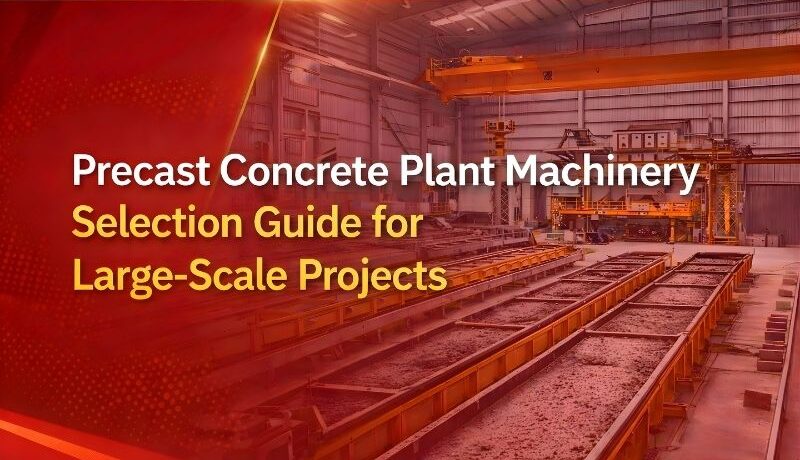
Precast Concrete Plant Machinery Selection Guide for Large-Scale Projects
Introduction
Large infrastructure and industrial projects demand speed, precision, and consistent quality. For companies planning to invest in a precast concrete plant, selecting the right machinery is a strategic decision that directly impacts productivity, cost control, and long-term profitability.
This guide explains how to evaluate and select the right precast plant machinery for large-scale projects in a practical, B2B-focused way.
Why Machinery Selection Matters in Large-Scale Projects
In large construction programs—such as metro rail, highways, industrial parks, smart cities, and mass housing—precast components must be produced in high volumes without compromising quality.
The success of precast concrete plant construction depends heavily on:
- Correct capacity planning
- Efficient batching and mixing systems
- Automated handling systems
- Reliable curing solutions
- Integrated quality control
“In large-scale construction, the right machinery is not an expense — it is a long-term productivity investment.â€
Step 1: Define Your Production Requirements
Before evaluating suppliers, clearly define your project scope.
Key Questions to Consider:
- What is the daily production capacity required?
- What type of precast elements will be produced (beams, slabs, columns, panels, girders)?
- Is the project temporary or long-term?
- Will the plant serve multiple projects?
Example Capacity Planning Table
| Project Type | Suggested Plant Capacity | Automation Level |
| Residential Housing | 40–60 m³/hr | Semi-Automatic |
| Industrial Structures | 60–90 m³/hr | Automatic |
| Metro / Infrastructure | 90+ m³/hr | Fully Automatic |
Selecting machinery without realistic capacity planning often leads to:
- Underutilized equipment
- Production bottlenecks
- Higher operational costs
Step 2: Evaluate Core Machinery Components
A modern precast concrete plant typically includes:
🔹 Batching and Mixing System
- High-precision weighing systems
- Twin-shaft or planetary mixers
- Moisture control integration
🔹 Mould Circulation or Fixed Production Systems
- Tilting tables
- Long-line beds
- Carousel systems
🔹 Material Handling Equipment
- Overhead cranes
- Concrete distribution buckets
- Automated pallet circulation
🔹 Curing Systems
- Steam curing chambers
- Controlled temperature systems
🔹 Control & Automation
- PLC-based automation
- Production tracking software
- Remote monitoring capabilities
For large-scale projects, automation is no longer optional—it improves consistency and reduces human error.
Step 3: Consider Layout & Plant Design
The efficiency of a precast plant is determined not only by machinery quality but also by plant layout.
Important layout considerations:
- Raw material storage positioning
- Internal transport flow
- Crane movement optimization
- Safe access pathways
- Future expansion space
Poor layout planning is a common real-world issue. Many contractors face:
- Traffic congestion inside the plant
- Delays in mould movement
- Material wastage due to poor logistics
Working with an experienced precast concrete plant manufacturer helps prevent these operational inefficiencies during the design stage.
Step 4: Assess Construction Timeline & Installation Support
Large projects cannot afford delays. During precast concrete plant construction, evaluate:
- Installation time
- Commissioning support
- Operator training
- Technical documentation
A professional precast concrete plant supplier should provide:
- On-site installation supervision
- Electrical integration support
- Trial production assistance
- After-sales service network
Step 5: Compare Local vs International Suppliers
India has emerged as a strong manufacturing hub for precast solutions. Many precast machinery manufacturers in India now provide advanced automation, competitive pricing, and strong service support.
Advantages of Choosing Established Indian Manufacturers:
- Faster spare parts availability
- Lower logistics costs
- Local technical support
- Customization for Indian site conditions
For infrastructure developers operating in India, working with a reliable precast concrete plant manufacturer locally often ensures better lifecycle support.
Step 6: Evaluate Long-Term ROI, Not Just Initial Cost
One common mistake in machinery selection is focusing only on capital expenditure.
Instead, evaluate:
- Power consumption
- Maintenance frequency
- Spare parts cost
- Downtime impact
- Scalability options
Cost Comparison Example
| Factor | Low-Cost Plant | High-Quality Automated Plant |
| Initial Investment | Low | Moderate |
| Maintenance Cost | High | Low |
| Production Efficiency | Moderate | High |
| Downtime Risk | High | Low |
| Long-Term ROI | Lower | Higher |
In large-scale infrastructure projects, downtime can cost lakhs per day. Reliable machinery reduces this risk significantly.
Common Real-Time Issues in Large Precast Plants
During operation, companies often face:
- Inconsistent concrete quality
- Equipment breakdown due to overload
- Poor curing leading to cracks
- Lack of trained operators
- Spare parts delays
How to Solve These Problems
- Invest in automated batching and moisture control
- Choose a supplier with strong after-sales service
- Conduct operator training programs
- Implement preventive maintenance schedules
- Maintain proper raw material quality checks
A well-planned precast concrete plant construction strategy minimizes these risks from the beginning.
Future-Proofing Your Investment
Modern precast projects demand flexibility. Choose machinery that allows:
- Modular expansion
- Integration with ERP systems
- Data-driven production monitoring
- Energy-efficient operations
Scalability is essential for companies targeting multiple infrastructure contracts over the next 5–10 years.
Final Thoughts
Selecting machinery for a precast concrete plant is a strategic decision that affects productivity, quality, and profitability. Large-scale projects require:
- Accurate capacity planning
- Reliable automation
- Efficient plant layout
- Strong supplier support
- Long-term cost optimization
By working with an experienced precast concrete plant supplier and evaluating technical, operational, and financial aspects carefully, construction companies can build a high-performance precast plant that delivers consistent results across projects.
For B2B decision-makers, the goal is not just installing equipment—it is creating a reliable production ecosystem that supports long-term infrastructure growth.
Partner with the Right Precast Machinery Expert
For large-scale projects, selecting an experienced machinery partner ensures long-term performance and reliability. Powerol is a trusted precast concrete plant manufacturer offering advanced, scalable precast plant solutions—from individual systems to complete turnkey setups.
With strong technical expertise and after-sales support, Powerol helps construction companies execute efficient precast concrete plant construction with confidence.
Learn more: https://powerol.com/
FAQs
What is a precast concrete plant?
A precast concrete plant is a controlled production facility where concrete components are manufactured using specialized machinery before being transported to construction sites.
What is involved in precast concrete plant construction?
Precast concrete plant construction involves layout planning, machinery installation, batching systems, curing setups, and automation integration for efficient production.
How do you choose the right precast plant machinery for large-scale projects?
The right precast plant machinery is selected based on production capacity, project requirements, automation level, and long-term scalability.
Why choose Powerol as your precast concrete plant manufacturer?
Powerol delivers reliable precast concrete plant solutions with advanced automation, turnkey support, and strong after-sales service for large-scale projects.
How does Powerol support precast concrete plant construction projects?
Powerol supports precast concrete plant construction with customized machinery design, technical expertise, and end-to-end installation assistance.