

- Your cart is empty Browse Shop
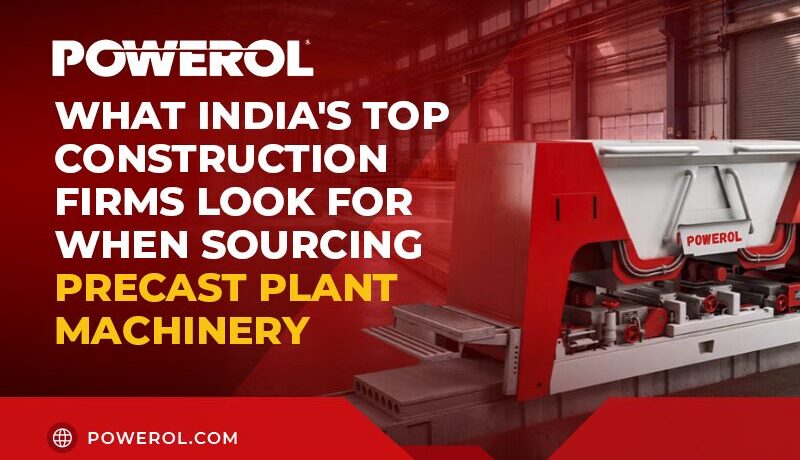
What India’s Top Construction Firms Look for When Sourcing Precast Plant Machinery
In India’s high-stakes infrastructure boom, precast plant machinery is either a growth engine or a hidden liability. The difference between the two is not luck; it’s the buying criteria you use. Serious buyers at L&T, JSW, HUL–level projects follow a clear, technical evaluation framework. Those who don’t often end up with frequent breakdowns, poor product quality, delayed projects, and crores lost in lifetime costs, not just lakhs.
For procurement heads, project managers, and promoters setting up a precast concrete manufacturing plant , choosing the right partner is now a strategic decision, not a one-time purchase. This guide breaks down exactly what India’s top construction firms look for in precast plant machinery , and why companies across metro rail, highways, affordable housing, and industrial estates prefer working with trusted, process-driven manufacturers like Powerol .
What is precast plant machinery and why your choice of supplier determines project success?
Precast plant machinery refers to the complete set of equipment used to produce factory-made concrete elements like slabs, beams, columns, wall panels, piles, and other structural components in a controlled environment. It includes batching systems, mixers, precast mould tables , vibration and compaction systems, handling equipment, curing systems, and often highly specialised lines like a hollow core slab machine or tilting tables.
For a modern precast concrete manufacturing plant , machinery directly impacts:
- Dimensional accuracy, surface finish, and structural quality
- Cycle times, production capacity, and labour efficiency
- Rejection rates, rework, and overall precast plant ROI in India
This is why leaders in precast concrete plant construction do not treat machinery as a commodity. They choose a precast concrete plant manufacturer who can engineer an integrated, site-specific solution, not just ship standalone equipment. For Indian construction majors, that often means partnering with a homegrown, innovation-focused construction machinery manufacturer in Chennai like Powerol , which combines global technology with deep understanding of Indian site conditions.
How top Indian construction companies choose precast plant machinery suppliers?
Top-tier players, whether it’s an L&T-like EPC contractor, a JSW-scale industrial developer, or an HUL-grade FMCG project owner, use a surprisingly structured approach when shortlisting a precast concrete plant supplier .
They typically look for five non-negotiables: customisation capability, manufacturing quality, installation and commissioning strength, after-sales support, and real track record.
At a high level, their framework answers three questions upfront:
- Will this precast concrete plant manufacturer deliver machinery that fits my product mix, volumes, and land constraints?
- Can they support pan-India execution with a strong service and spares backbone?
- Are they proven on real projects – metro rail, highways, industrial estates, affordable housing, not just on paper?
The rest of this guide breaks down those criteria in detail so your team can evaluate suppliers with the same rigour as India’s top construction brands.
Criterion 1: Customisation capability – Will the machinery fit your product mix, site, and growth plan?
Serious buyers know that no two precast plant setups in India are identical. A metro rail girder casting yard, for example, has very different requirements from an affordable housing precast wall panel plant or a hollow core slab unit for industrial sheds.
A reliable precast machinery manufacturer in India will start with engineering, not with a catalogue. When assessing customisation capability, top construction firms look at:
Product mix fit
They ask:
- Can the supplier design moulds and lines for my target elements—walls, columns, beams, hollow core slabs , staircases, boundary walls, or custom elements?
- Do they have experience designing precast mould tables and lines for similar project types—metro rail segments, highway elements, or large-format wall panels for mass housing?
A company like Powerol , for example, is known for tailoring concrete and asphalt machinery to specific application needs, and this philosophy carries into precast equipment engineering.
Site layout and constraints
Top firms rarely have a blank slate. They evaluate whether the partner can:
- Design plant layouts around site constraints (irregular plots, brownfield sites, limited headroom)
- Optimise logistics flows of concrete, steel, and finished elements
- Integrate the plant with existing batching systems, yards, and crane infrastructure
A vendor with real design expertise will present layout options and simulations, not just generic 2D drawings.
Capacity and future scalability
Finally, serious buyers do not over- or under-buy. They look for:
- Modular production lines that can be expanded as volumes grow
- Flexibility to add a precast concrete production line later (e.g., adding hollow core slabs after starting with wall panels)
- Clear guidance on how the plant can scale from initial volumes to future project pipeline
When a supplier like Powerol talks about “powering the world” with technology-led machinery, this scalability mindset is at the core of their engineering approach.
Criterion 2: Manufacturing quality – Steel grade, in-house design, and robust QC
Once customisation is proven, high-quality firms dig deep into how the machinery is actually built. The difference between a robust, long-life precast concrete plant and an unreliable one often comes down to invisible details in steel, welding, machining, and QC.
Steel grade and fabrication standards
Top buyers ask:
- What grades of steel are used in structural members and mould surfaces?
- How are wear-prone surfaces treated or hardened?
- Are welds tested (NDT, visual inspection, bend tests) and are welders certified?
A company that has invested in precision fabrication, as Powerol has across its product lines, will be transparent about these details.
In-house design and engineering expertise
Engineering ownership is a key indicator of long-term support. Top companies prefer a precast concrete plant manufacturer that:
- Designs frames, moulds, and mechanisms in-house using advanced CAD/CAE tools
- Runs structural and vibration analyses on critical components
- Can quickly modify or optimise designs based on feedback from Indian sites
This ensures the plant is not just assembled from imported sub-systems with limited scope for modification.
Quality control process and testing
Before dispatch, serious buyers expect to see:
- Factory acceptance tests on major assemblies
- Dimensional checks on moulds and tables
- Run tests for moving mechanisms, hydraulics, and control systems
Powerol’s reputation as a reliable construction equipment manufacturer stems from its focus on stringent QC and a culture of engineering-led improvement across its facilities.
Already evaluating manufacturing quality and engineering depth in your shortlist? That’s exactly where Powerol’s plants are built to hold up.
[Talk to Powerol’s precast machinery team →]
Criterion 3: Installation, commissioning, and operator training – From equipment delivery to stable production
Many buyers underestimate this part of the journey. For top Indian construction firms, a precast concrete plant construction project is not “supplied” until the plant is safely producing at the right output and quality.
On-site installation and alignment
They evaluate whether the supplier can:
- Provide experienced erection teams or closely supervise local contractors
- Ensure accurate alignment and levelling of precast mould tables , circulation systems, and production lines
- Coordinate with civil, electrical, and crane vendors on interfaces
Companies with a pan-India footprint, like Powerol , have an advantage here because they understand practical site realities across different states and terrains.
Commissioning and trial production
Top-level clients also insist on:
- Structured commissioning plans with clear timelines
- Trial production runs to validate product quality, cycle times, and safety
- Fine-tuning of vibration, compaction, and concrete handling parameters
Instead of simply handing over manuals, a strong precast concrete machinery supplier stays on site until performance is proven.
Operator and maintenance team training
Finally, long-term success depends on people. Quality suppliers provide:
- Training for operators on safe and efficient machine use
- Maintenance training covering lubrication points, checks, and common troubleshooting
- Multilingual documentation where needed for local teams
Powerol’s teams, for example, are known for hands-on, practical training that bridges the gap between design intent and field execution.
Criterion 4: After-sales support – Spares, service, and uptime assurance
For many procurement heads, this is the single biggest fear: “What if the plant stops? Who will support us?” Serious decision-makers consider after-sales support for precast machinery as a core buying criterion, not an afterthought.
Spares availability and lead times
They expect a strong precast machinery manufacturer in India to:
- Maintain stock of critical wear parts and consumables
- Provide clear lead times for non-stock items
- Offer recommended spares lists for Year 1, 2, and 3 operations
This is where having a national after-sales network and pan-India delivery capability becomes a major advantage for a supplier like Powerol .
Service engineer network and response time
For high-output plants supplying metro rail, highway, or housing projects, every hour of downtime costs money. Buyers ask:
- How many service engineers are deployed across India?
- What is the typical response time to major project hubs?
- Is remote diagnostic support available for electrical/software issues?
The best partners commit to SLAs and back them with real field teams, not just promises.
Lifecycle partnership mindset
Top Indian firms look for partners who think in terms of lifecycle value, not just initial sale. That includes:
- Preventive maintenance plans
- Periodic audits of plant performance
- Upgrade and retrofitting options as production needs evolve
Powerol’s positioning as a long-term “power partner” makes this lifecycle approach central to its offering.
Criterion 5: Track record and client credibility – Who have they actually supplied to?
In B2B capital equipment, proof is everything. India’s leading contractors and developers know that buying from a proven precast concrete plant supplier lowers technical and commercial risk.
Real project references
They ask:
- Has the supplier supported projects similar to ours—metro rail, industrial estates, affordable housing, or expressways?
- Can they share case studies showing production metrics, uptime, and timelines?
When a manufacturer like Powerol talks about prestigious global clients and Indian majors, it gives comfort that the machinery has been tested in demanding environments.
Recognised clients and repeat orders
Names matter, but patterns matter more. Top firms look for:
- Supplies to brand-name customers (for example, L&T-type EPCs, JSW-scale industrial corporations, HUL-type FMCG projects)
- Evidence of repeat orders or plant expansions
While you should never over-claim, even being part of supply chains servicing such brands signals that the manufacturer understands high-spec, time-bound construction environments.
Certifications and compliance
Finally, both Indian and overseas buyers check:
- ISO certifications for quality and environmental management
- Compliance with Indian and relevant international standards
- Safety standards adhered to in design and manufacturing
This gives confidence that Indian precast plant machinery can match international benchmarks, an especially critical factor for overseas buyers evaluating suppliers from India.
Quick 10-point checklist for evaluating a precast plant machinery supplier
Use this simple, practical checklist when comparing vendors. Ideally, your chosen partner should tick almost every box:
- Can they configure a plant tailored to your product mix (walls, beams, hollow core slabs, boundary walls, etc.) and volumes?
- Have they shared at least one detailed proposed layout based on your actual land and site constraints?
- Do they design and engineer major structures, moulds, and mechanisms in-house?
- Can they clearly explain steel grades, welding standards, and QC processes for their equipment?
- Do they provide full installation and commissioning support, not just shipping and remote guidance?
- Is structured operator and maintenance training part of their standard scope?
- Do they have a pan-India service team and committed response times for breakdowns?
- Are recommended spares and typical lead times clearly documented in their proposal?
- Can they share references from comparable projects (metro, highways, housing, industrial estates) and reputed clients?
- Do they offer lifecycle support—health audits, upgrades, and expansions—beyond the initial precast plant installation in India ?
If you apply this checklist rigorously, you will naturally gravitate toward manufacturers with the scale, systems, and mindset of Powerol .
Powerol – The trusted partner that meets real-world precast machinery criteria
When you map these criteria to the Indian market, Powerol stands out as a technology-led, credibility-rich choice for precast plant machinery buyers.
As a construction machinery manufacturer from Chennai with a strong reputation in concrete and asphalt equipment, Powerol brings:
- Deep engineering capability, enabling tailored plant configurations for diverse precast products
- Robust manufacturing standards backed by experienced engineering teams and stringent QC
- Multiple manufacturing locations and a growing pan-India footprint that supports fast delivery and service
- A culture of on-ground support—installation, commissioning, and operator training are integral to how Powerol executes projects
- A respected client base across India and global markets, adding confidence for both domestic and overseas buyers
For procurement heads, developers, and investors looking to set up or scale their precast concrete manufacturing plant , Powerol combines the agility of an Indian manufacturer with the reliability and process orientation associated with global suppliers.
FAQs
- What is precast plant machinery?
Precast plant machinery is the integrated set of equipment used to produce precast concrete elements – such as slabs, beams, columns, wall panels, and piles—in a controlled factory environment. It includes batching and mixing systems, precast mould tables , vibration and compaction equipment, curing systems, handling and lifting equipment, and specialised systems like hollow core slab machines and circulation lines.
- What should I look for in a precast concrete plant manufacturer?
Look for a precast concrete plant manufacturer that can tailor the plant to your product mix and site constraints, demonstrates high manufacturing quality (steel grades, welding, machining, QC), offers comprehensive installation and commissioning support, and has a strong after-sales and spares network. Proven references on similar projects and transparent engineering details are essential.
- What is the difference between a precast concrete plant and a precast production line?
A precast concrete plant is the entire facility—the land, civil works, batching and mixing systems, handling equipment, and multiple production lines—designed to produce various precast elements. A precast concrete production line is a specific line within that plant, usually dedicated to a particular product family (for example, a wall panel line, a hollow core slab line, or a beam/column line). Plants often start with one or two lines and expand over time.
- How do I evaluate a precast concrete plant supplier in India?
Use a structured framework covering customisation, quality, installation/commissioning, after-sales, and track record. Ask for tailored layouts, technical details on fabrication and QC, clear documentation of after-sales support for precast machinery , and references from metro rail, highway, housing, or industrial projects. Visit at least one operating plant supplied by the vendor, where possible, to see actual performance.
- What after-sales support should a precast machinery manufacturer provide?
The right partner should offer a national service engineer network, committed response times, recommended spares lists, local or regional spares stocking, remote troubleshooting support, and periodic health checks or audits. Training for your operations and maintenance teams should be part of standard scope, not an optional extra. This is key to maximising precast plant ROI in India over the plant’s lifespan.
- How do I set up a precast concrete manufacturing plant in India?
Start by defining your target products (walls, beams, slabs, etc.), projected volumes, and project types (metro, highways, affordable housing, industrial estates). Then, engage a specialist precast concrete plant supplier like Powerol to design site-specific layouts, choose the right capacity, and plan infrastructure (foundations, cranes, power, curing systems). A capable partner will guide you from concept to precast plant installation in India , including commissioning and operator training.
- Which companies supply precast plant machinery in India?
India has a mix of local and global suppliers active in the precast machinery manufacturer India space. Buyers increasingly prefer trusted domestic partners like Powerol , who combine strong engineering, competitive pricing, and pan-India service with the ability to meet international quality expectations making them suitable for both Indian and overseas customers evaluating Indian sources.
If you are evaluating precast plant machinery for metro rail, highway, industrial, or housing projects, partnering with a trusted, engineering-led manufacturer like Powerol dramatically reduces risk and accelerates returns. To explore tailored plant layouts, product-mix-specific solutions, and pan-India lifecycle support, reach out to the Powerol team today and take the next step towards a high-performance precast facility.