


- Your cart is empty Browse Shop
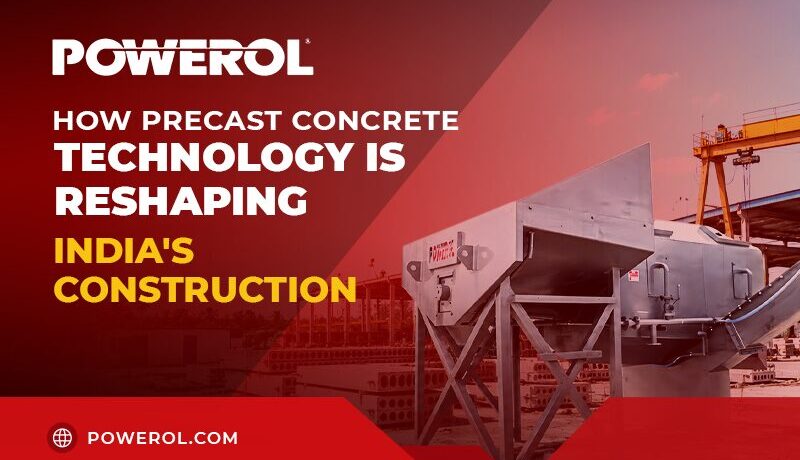
How Precast Concrete Technology Is Reshaping India’s Construction
India’s precast concrete technology market is growing at an estimated 11.1% CAGR , driven by expressways, affordable housing, and Smart Cities projects that demand faster, higher‑quality construction than traditional methods can deliver. For contractors, developers, and investors, the real game-changer is not just the concrete itself, but the precast concrete production line and the machinery behind it.
This article explains how precast concrete technology works , how a precast concrete manufacturing plant is set up, and why choosing the right construction machinery manufacturer in India can make or break your ROI, using the lens of Powerol’s expertise in concrete and asphalt machinery.
What is precast concrete technology?
Precast concrete technology is a construction method where concrete elements like walls, slabs, beams, columns, and infrastructure components are cast in a controlled factory environment, cured, and then transported to the site for installation. Instead of pouring concrete on-site (in-situ), precast shifts the critical work into a precast concrete manufacturing plant , where quality, speed, and repeatability are significantly higher.
In India, precast concrete elements are increasingly used for residential towers under PMAY , industrial sheds for clients like JSW and HUL , commercial buildings for developers working with L&T , as well as bridges, metro systems, and highway structures under MoRTH’s National Highway Precast Mandate and PM Gati Shakti . This factory-first model reduces on-site labour dependency, minimizes weather risk, and helps projects meet aggressive timelines and quality benchmarks.
At a high level, precast concrete technology involves three pillars: engineered design (often with BIM precast integration ), industrialized production in a plant, and rapid assembly at site using cranes and lifting systems. For B2B buyers, understanding how the underlying machinery works is the key to making confident investment decisions.
How does a precast concrete production line work?
A precast concrete production line is a coordinated sequence of machinery and processes that convert raw materials – cement, aggregates, water, steel into finished precast elements ready for dispatch. It typically includes batching, mixing, casting, vibration, curing, demoulding, finishing, storage, and loading.
In simple terms: a precast line is a factory conveyor for buildings.
Here’s a step‑by‑step breakdown of how a modern precast plant typically operates.
- Design, detailing, and BIM integration
Before a single cubic metre of concrete is poured, engineers and contractors finalize designs, often using BIM precast integration tools to model every precast concrete element – panels, hollow core slabs, beams with embedded lifters, inserts, and reinforcement.
This stage defines:
- Types of elements (e.g., wall panels, hollow core slab units, staircase flights)
- Load paths and structural performance
- Mould dimensions and reinforcement schemes
Accurate digital models reduce clashes on site, optimize reinforcement quantities, and drive automation in cutting and bending steel.
- Batching and mixing: the heart of consistency
A dedicated precast batching plant supplies concrete to the production lines. Unlike site-mixed concrete, here every batch is monitored for water–cement ratio, slump, and temperature.
Key machinery at this stage includes:
- Aggregate and cement silos with automated weighing
- High‑precision batching plant for consistent mix designs
- Planetary or twin‑shaft mixers designed for precast mixes with low water content
- Concrete distribution systems (bucket conveyors, travelling buckets, or pumps)
This is where Powerol’s expertise in concrete equipment gives Indian plants a serious advantage, robust batching and mixing systems built for Indian raw materials and climatic conditions.
- Moulds, beds, and formwork systems
Next, the plant prepares moulds:
- Fixed steel moulds for columns, beams, and façade panels
- Long-line casting beds for planks and hollow core slab machinery
- Battery moulds for high‑volume wall production
Machinery here includes:
- Mould tilting tables
- Hydraulic formwork systems
- Vibration tables for compaction
For hollow core slabs, automated precast factory setups use slipformers or extruders that move along long beds, consolidating concrete and forming continuous slabs.
- Reinforcement cutting, bending, and cage welding
Reinforcement is processed in a dedicated area:
- Cutting and bending machines for rebar
- Mesh welding lines for panels
- Cage welding machines for beams and columns
In semi-automated and automated plants, this section talks directly to the BIM model—reducing steal wastage and manual errors.
- Casting and vibration
Once moulds are cleaned, oiled, and reinforced, concrete is poured:
- Concrete is placed using buckets, pumps, or gantry-mounted distributors
- Internal and external vibrators ensure proper compaction
- Surface screeds and levellers create a uniform finish
This is where the quality of precast concrete machinery is most visible—poor vibration or uneven distribution leads to honeycombing and rework.
- Curing and steam systems
After casting, elements are cured to achieve early strength:
- Steam curing systems or hot‑air chambers accelerate early strength gain
- Controlled temperature and humidity prevent thermal shock and cracking
A well‑designed curing regime allows demoulding within hours instead of days, which is vital for high‑throughput precast plant construction .
- Demoulding, finishing, and storage
When target strength is reached:
- Overhead cranes or gantry systems lift elements from moulds
- Edges are finished, lifting anchors inspected, minor defects repaired
- Elements are stored in organized racks or yards, tagged with unique IDs
All of this flows like a production line, with safety, ergonomics, and logistics carefully planned.
- Dispatch and site assembly
Finally, precast elements are loaded onto trailers, transported to site, and erected with cranes, following an installation sequence mapped at the design stage. This is where the time savings of precast construction India 2026 become obvious: foundations, columns, and slabs can rise in days instead of weeks.
How is precast technology reshaping India’s construction industry?
Precast concrete technology is reshaping India’s construction landscape by turning building into an industrial process driven heavily by government mandates, urbanisation, and a shift toward quality‑assured infrastructure.
At a glance, precast is transforming India in three big ways.
- Government schemes and mandates are demanding speed and quality
Several flagship initiatives are directly or indirectly nudging the industry toward precast:
- PMAY (Pradhan Mantri Awas Yojana): Millions of affordable homes demand replicable designs and fast cycle times—ideal for precast wall and slab systems.
- Smart Cities Mission: Urban infrastructure, parking structures, podiums, and transit hubs favor factory-made components for minimal disruption and faster delivery.
- PM Gati Shakti: The national masterplan for multi‑modal connectivity relies on rapid deployment of bridges, culverts, and logistics parks, where precast underpasses, retaining walls, and structural elements shine.
- MoRTH National Highway Precast Mandate: The Ministry of Road Transport & Highways has been strongly pushing government precast mandate India for culverts, drains, crash barriers, and bridge components, standardizing designs and encouraging industrialized production.
Developers and EPCs working with clients like L&T , JSW , and HUL are under pressure to deliver high‑quality assets quickly, with consistent finishes and predictable performance. Precast answers that.
- Labour constraints and safety expectations
India’s construction sector faces rising labour costs, skill shortages, and stricter safety expectations from global investors and MNC clients. Precast moves critical activities off-site into a controlled environment where:
- Fewer workers can produce more output
- Safety can be systematically managed
- Quality is not at the mercy of site‑level variability
By 2026, precast construction India 2026 is expected to be a standard consideration in large residential, industrial, and infrastructure bids—especially in metros and Tier‑1 cities.
- Market growth and investor interest
Industry reports place India’s precast market growth at around 11.1% CAGR , making it one of the fastest‑growing verticals within construction materials. That is why investors, developers, and even traditional contractors are exploring:
- Greenfield precast concrete manufacturing plants
- Project‑specific mobile plants for highways and industrial parks
- Upgrades from manual yards to automated precast factory setups
For all of them, the question is less “Should we go precast?” and more “What is the right scale and machinery configuration for us?”
What machinery does a precast concrete manufacturing plant need?
A modern precast concrete manufacturing plant combines heavy-duty mechanical systems with automation and digital controls. The mix of machinery you choose determines your productivity, quality, and ROI.
Here are the core machinery groups to consider.
Core concrete and production machinery
- Precast batching plant: The backbone of mix consistency, with automated weighing, high‑shear mixers, moisture probes, and data logging.
- Concrete distribution systems: Travelling buckets, gantry conveyors, or pump lines to feed multiple production beds with minimal manual handling.
- Mould systems and beds: Tilting tables, battery moulds, tunnel form moulds, and long casting beds tailored to your product mix.
This is where Powerol’s experience as a construction machinery manufacturer India comes into play – designing batching, conveying, and compaction equipment that works reliably in Indian conditions.
Specialised precast machinery
- Hollow core slab machinery: Extruders or slipformers for continuous slab production, integrated with cutting machines and strand tensioning.
- Vibration systems: External shutter vibrators, internal needle vibrators, and vibration tables tuned for high‑strength precast mixes.
- Steam curing systems: Boilers, piping, and curing chambers or covers that maintain optimal temperature and humidity for accelerated curing.
Handling and logistics
- Overhead cranes and gantry cranes for demoulding and storage
- Tilting stations and turning devices for safe handling of large panels
- Yard logistics equipment like forklifts, trailers, and stacking systems
Automation and control systems
- SCADA and PLC systems for plant‑wide monitoring
- Production planning software linked to BIM models
- Quality control systems for mix parameters, strength tracking, and traceability
For new entrants, it’s easy to feel overwhelmed. That’s why working with a machinery partner that can design and supply a complete precast concrete production line —from batching to finishing is critical.
What to look for in a precast plant setup: manual, semi‑auto, or fully automated?
One of the biggest doubts B2B buyers have is whether to start small or jump straight to automation. The right answer depends on your volume, target market, and financing.
Here’s a practical view.
Manual / low‑automation precast setup
Best for:
- Small regional contractors serving local housing or boundary wall demand
- Project‑based plants for one or two large contracts
Characteristics:
- Basic precast batching plant with partial automation
- Simple steel moulds, manual reinforcement placement
- Limited or no steam curing system (longer cycles)
- Lower capex, higher labour dependence, slower output
Semi‑automated precast plant
Best for:
- Contractors and developers targeting repeat projects in housing, industrial sheds, and small bridges
- Investors testing the waters before scaling up
Characteristics:
- Automated batching and concrete distribution
- Improved mould systems, tilt tables, and better vibration equipment
- Basic curing systems (steam or hot air, at least for critical elements)
- Some automation in reinforcement processing
This is the “sweet spot” for many Indian buyers, not too capex‑heavy, but with enough mechanization to deliver consistent volumes.
Fully automated precast factory
Best for:
- Large infrastructure players, REIT‑backed developers, and conglomerates
- Long‑term pipeline of projects in multiple cities
Characteristics:
- Highly automated precast concrete production line with carousel systems, robotic spreading, automatic compaction
- Fully integrated automated precast factory software, BIM, and MES systems
- Sophisticated steam curing systems and energy optimization
- Highest productivity and lowest unit cost at scale
Powerol helps buyers evaluate which level of automation is justified by their pipeline, financing, and risk appetite, so they don’t over‑ or under‑invest.
👉 Not sure which configuration suits your pipeline and budget? Explore Powerol’s precast plant solutions →
What are the benefits of precast concrete technology for contractors?
For contractors and developers, precast concrete technology is not just a technical upgrade, it’s a competitive strategy.
Some of the most tangible benefits include:
Faster project delivery: Factory production runs in parallel with foundation and site works, compressing overall timelines. For PPP and EPC contracts with heavy penalties, this is critical.
Predictable quality: Controlled factory conditions, standard moulds, and repeatable mixes ensure compliance with international quality standards for strength, durability, and dimensional accuracy.
Lower lifecycle costs: Better finishes, fewer cracks, and higher durability reduce maintenance and lifecycle costs for infrastructure assets.
Better resource utilization: Optimised reinforcement, reduced cement wastage, and efficient curing improve sustainability and margins.
Brand perception: For clients like L&T , HUL , and JSW , working with partners using modern precast systems signals reliability, professionalism, and global‑standard practices.
Is precast construction better than traditional construction in India?
For many project types, precast construction offers clear advantages over traditional in‑situ methods, especially in India’s current context.
Precast is typically better when:
- The design is repetitive: Housing, hostels, hotels, and industrial units.
- Timelines are tight: Highways, metro projects, logistics parks under PM Gati Shakti .
- Quality and durability are non‑negotiable: Bridges, viaducts, data centres.
Traditional construction may still be suitable for:
- Very small or one‑off buildings
- Projects in extremely remote locations where plant setup is not viable
However, as logistics networks expand and government precast mandate India strengthens, the tipping point is shifting: more and more projects will expect or require precast solutions in their tenders.
Understanding precast concrete ROI and risk
A common hesitation is: “Should we invest now in a precast concrete manufacturing plant , or wait?”
To answer that, you need clarity on precast concrete ROI .
Key drivers of ROI include:
- Annual production volume: More tonnes or square metres per year dilute fixed costs.
- Mix of elements: High‑value elements (like hollow core slabs or façade panels) improve margins.
- Automation level: Automation increases capex but reduces labour and defects.
- Pipeline visibility: Secured projects under PMAY , Smart Cities Mission , or major private clients like L&T drive confidence.
Typical investors look at a 4–7 year payback window, but well‑utilised plants with strong order books can achieve faster payback.
The biggest risk is not technology, it is misalignment between plant capacity, machinery configuration, and realistic market demand. That is why working with an experienced construction machinery manufacturer India is critical during the planning phase.
Why the right precast machinery partner matters – Powerol’s edge
When you invest in precast concrete technology , you are not just buying equipment; you are building a long‑term production ecosystem that must run reliably for 10–20 years. The wrong partner can lock you into outdated machinery, long downtimes, and expensive imported spare parts.
Powerol brings a different approach:
Deep domain experience: As a trailblazer in the Indian construction machinery industry , Powerol has worked across concrete and asphalt equipment, serving demanding clients in highways, industrial, and urban infrastructure.
End‑to‑end thinking: From batching and mixing to handling and curing, Powerol’s portfolio and engineering teams help you design the complete precast plant construction layout—not just sell standalone machines.
Built for Indian conditions: Powerol’s machines are designed for Indian aggregates, climate, and operating conditions, while still targeting international quality standards for performance and safety.
Local service, global mindset: With manufacturing plants and service teams across India, Powerol can support installation, training, after‑sales service, and spares without the delays and costs typical of overseas suppliers.
Future‑ready upgrades: As you grow from manual to semi‑auto and eventually to higher automation, Powerol can help you phase investments, protecting you from premature obsolescence while keeping your precast concrete production line competitive.
For contractors, developers, and investors who want a reliable Indian partner that understands both machinery and real project constraints, Powerol is positioned as a long‑term ally.
FAQs
- What is precast concrete technology in simple terms?
Precast concrete technology means casting concrete components like walls, slabs, and beams in a controlled factory, curing them, and then transporting them to site for quick installation, instead of casting them in place. - What machinery does a basic precast plant need?
At a minimum, you need a precast batching plant , steel moulds, vibration equipment, lifting and handling systems, and a basic steam curing system or controlled curing arrangement. As volume grows, you add hollow core slab machinery , reinforcement processing, and automation. - How does a precast concrete production line differ from traditional RMC?
A precast concrete production line doesn’t just produce concrete; it produces finished building elements. It integrates batching, moulding, curing, demoulding, finishing, and storage as one continuous process, guided by engineering drawings and often linked to BIM. - Are government schemes really supporting precast?
Yes. PMAY , Smart Cities Mission , PM Gati Shakti , and the MoRTH National Highway Precast Mandate are all pushing toward faster, standardised, and higher‑quality construction, where precast plays a central role in bridges, culverts, housing, and urban infrastructure. - How do I choose between manual, semi‑auto, and automated plants?
Your decision should be based on expected annual volume, project pipeline, financing capacity, and risk appetite. Many Indian buyers start with semi‑automated setups and then move to automated precast factory solutions as order books grow. A partner like Powerol can help model scenarios and design the right configuration.
If you are evaluating precast concrete technology for your next phase of growth, whether you are a contractor upgrading from cast‑in‑situ, a developer planning a dedicated precast unit, or an investor entering building materials, this is the time to move from curiosity to action. Speak to Powerol’s team of precast machinery experts to design the right plant layout, select the optimal equipment mix, and build a future‑ready precast concrete technology ecosystem that delivers speed, quality, and ROI for years to come.