

- Your cart is empty Browse Shop
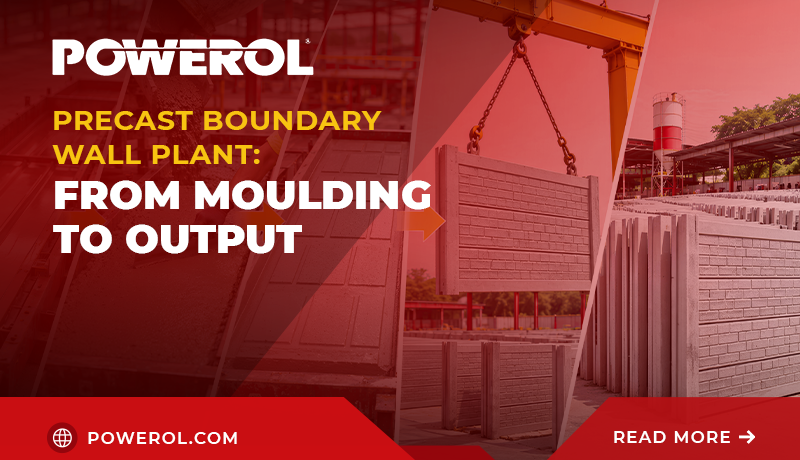
Precast Boundary Wall Plant: From Moulding to Output
Scalable boundary-wall production requires more than additional labour. When mould filling, compaction, curing and material handling are managed manually, manufacturers often face inconsistent dimensions, slow mould turnaround, uneven concrete quality and difficulty increasing daily output. A mechanised precast boundary wall plant brings these activities into a coordinated production workflow, helping manufacturers improve repeatability, reduce handling delays and plan output more efficiently.
For precast manufacturers, contractors, infrastructure companies and construction-material businesses, the right production setup can support a transition from labour-intensive manufacturing to a dependable precast concrete production line . Powerol provides precast plant machinery and integrated production solutions for different output requirements, including equipment for compound walls, wall panels, beams, columns and other precast products.
How Does a Precast Boundary Wall Plant Work?
A precast boundary wall plant converts proportioned raw materials into reinforced or plain concrete wall panels through a sequence of controlled operations:
Batching → Mould preparation → Reinforcement placement → Concrete filling → Vibration and compaction → Curing → Demoulding → Finishing → Storage and dispatch
Each stage affects the next. Accurate batching supports consistent strength, properly prepared moulds help maintain dimensions, controlled vibration removes unwanted air pockets, and organised curing improves production planning. The purpose of mechanisation is not simply to add machines, but to connect these stages into a smoother and more predictable manufacturing system.
Complete Precast Boundary Wall Manufacturing Workflow
- Batching and Concrete Preparation
Production begins with the controlled proportioning of cement, aggregates, water and approved admixtures, according to the required product specification. Manual measurement can create variation between batches, particularly when material moisture, aggregate grading or operator judgement changes.
A batching and mixing system improves control by measuring materials more consistently and producing a uniform concrete mix. The mixer should be selected according to the required panel size, concrete grade, production cycle and expected daily output.
For a boundary-wall production line, the concrete mix must have suitable workability for mould filling while remaining stable during vibration. Excessively fluid concrete can affect panel geometry, while a stiff mix may not flow properly around reinforcement or into corners.
- Mould Preparation
Moulds determine the final dimensions, surface profile and repeatability of each boundary-wall panel. Before filling, operators clean the mould, inspect joints and apply a suitable release agent. Any leftover concrete, damaged edge or incorrect alignment can create surface defects and dimensional variation.
A mechanised precast plant should include a designated mould-preparation zone close to the casting area. This reduces unnecessary movement and supports faster mould turnaround. Moulds should be designed for safe handling, easy cleaning and repeated use.
For manufacturers producing different wall designs, interchangeable mould configurations can help the plant respond to varied project requirements without rebuilding the entire production system.
- Reinforcement Placement and Concrete Filling
Where the design requires reinforcement, steel bars, mesh or inserts are positioned inside the mould before concrete placement. Correct cover and alignment are essential for product quality and durability.
Concrete is then transferred from the mixing area to the moulds using suitable handling equipment. Depending on the layout and output target, this may involve concrete buckets, transfer systems, overhead cranes or other material-handling arrangements.
The filling sequence should be consistent. Operators should avoid placing all concrete at one point if this causes segregation or uneven distribution. Controlled filling also reduces the amount of corrective work needed before vibration.
- Vibration and Compaction
Compaction is one of the most important stages in precast concrete manufacturing . Air trapped inside the mould can result in honeycombing, voids, weak edges and poor surface finish. Manual poking or inconsistent external vibration may not compact every section equally.
A precast concrete vibrating table or an integrated vibration system applies controlled vibration to the mould and concrete. It helps the mix flow around reinforcement, fill corners and achieve a denser finished panel.
The vibration system should be matched to mould weight, product dimensions and concrete workability. Excessive vibration can cause segregation, while insufficient vibration can leave air pockets. A repeatable vibration cycle makes quality less dependent on individual operator technique.
- Curing
After casting, the concrete must gain sufficient strength before demoulding and handling. Curing conditions influence strength development, surface quality and cycle time.
A plant layout should provide a clearly defined curing area with adequate space between panels. Depending on the production model and climate, manufacturers may use controlled moisture retention, covered curing zones or accelerated curing systems. In larger production setups, curing chambers may help shorten cycle times and improve production planning.
Curing delays often become a bottleneck when manufacturers increase mould quantity without expanding the curing and handling area. Capacity planning must therefore consider the complete cycle, not only the mixing or casting rate.
- Demoulding
Once the panel reaches the required handling strength, it is removed from the mould. Demoulding should be carried out carefully to prevent chipped edges, cracks and damage to the mould.
Suitable lifting points, cranes, handling fixtures or demoulding arrangements can make this stage safer and faster. The plant should provide enough space for operators and equipment to move around the moulds without obstructing active casting operations.
Faster demoulding improves mould availability, but it should never compromise the strength requirements of the panel. The correct demoulding time depends on the concrete mix, curing method, product design and site conditions.
- Finishing and Quality Inspection
After demoulding, each panel can be checked for dimensions, surface quality, edge condition, reinforcement visibility and other project-specific requirements. Minor finishing activities may include removing fins, cleaning edges or repairing approved surface imperfections.
Quality inspection should be integrated into the workflow rather than treated as a final activity only. Early identification of mould or compaction problems helps prevent repeated defects across an entire production batch.
- Storage and Dispatch
Finished panels require organised storage to avoid damage and unnecessary rehandling. Panels should be placed on stable supports, with appropriate spacing and safe access for lifting equipment.
The storage yard should be planned according to panel dimensions, production volume, dispatch frequency and vehicle movement. Poor storage planning can reduce the effective capacity of an otherwise efficient precast plant.
Machinery Required for a Precast Boundary Wall Plant
| Production stage | Typical machinery or system | Contribution to output |
| Material proportioning | Concrete batching plant | Improves batching accuracy and mix consistency |
| Mixing | Concrete mixer | Produces uniform concrete for repeated cycles |
| Mould preparation | Precast moulds and mould tables | Supports repeatable dimensions and faster turnaround |
| Reinforcement | Reinforcement cutting, bending or placement equipment | Improves consistency in steel preparation |
| Concrete transfer | Concrete bucket, transfer system or handling equipment | Reduces manual movement and spillage |
| Filling and compaction | Precast concrete vibrating table or vibration system | Reduces voids and improves surface finish |
| Curing | Curing area, covered zone or curing chamber | Supports predictable strength development |
| Demoulding | Overhead gantry crane, lifting fixtures or handling equipment | Improves safety and reduces handling time |
| Storage | Panel supports and yard-handling systems | Reduces damage and improves dispatch organisation |
Powerol’s precast machinery range includes batching and mixing plants, mould tables, vibration and compaction systems, curing chambers, overhead gantry cranes and reinforcement-processing equipment. The final selection depends on the product design, available land, required output, level of automation and expansion plan.
How Can Boundary-Wall Production Be Increased?
Increasing output is not achieved by adding moulds alone. Manufacturers should first identify the slowest stage in the production cycle. Common bottlenecks include concrete preparation, mould cleaning, vibration, curing, demoulding and yard handling.
A practical approach includes:
- Improving batching and mixing consistency to reduce rejected batches.
- Using moulds designed for quick cleaning and release.
- Standardising the filling and vibration cycle.
- Expanding curing space before increasing casting volume.
- Introducing lifting and handling equipment to reduce manual movement.
- Creating separate zones for raw materials, casting, curing, finishing and storage.
- Planning shift-wise mould utilisation and equipment availability.
- Selecting machinery that allows future product or capacity expansion.
A complete precast concrete plant should be planned around the required output rather than a single machine. For example, a high-capacity mixer will not increase production if the mould bank, curing area or handling system cannot support its output.
Plant Layout Considerations for Indian Manufacturers
Indian manufacturers may need to balance land availability, power supply, labour access, climate, transport requirements and future expansion. The layout should minimise backtracking between batching, casting, curing and storage areas.
A practical arrangement usually places raw-material storage near the batching section, followed by mixing and concrete transfer. Mould preparation and casting should be positioned close to vibration equipment. Curing and demoulding areas should have sufficient circulation space, while the final storage yard should allow safe loading onto transport vehicles.
The plant should also account for monsoon conditions, dust control, drainage, electrical safety and access for installation and maintenance teams. Choosing an Indian supplier can simplify communication, commissioning and service coordination. Powerol manufactures construction machinery in India and supports customers with installation, commissioning and national after-sales assistance.
Practical Precast Plant Setup Checklist
Before investing in a precast boundary wall plant, manufacturers should evaluate:
- Required daily and monthly output.
- Boundary-wall panel dimensions and mould designs.
- Concrete grade, reinforcement requirements and mix characteristics.
- Number of moulds required per production cycle.
- Batching and mixer capacity.
- Vibration and compaction method.
- Curing area and expected demoulding time.
- Crane, lifting and material-transfer requirements.
- Electrical load, water supply and drainage.
- Factory floor strength and available working space.
- Raw-material storage and finished-product yard.
- Vehicle access for dispatch.
- Installation, operator training and commissioning support.
- Availability of spare parts and after-sales service.
- Scope for adding moulds or equipment in the future.
FAsQs
- How does a precast boundary wall plant work?
A precast boundary wall plant batches and mixes concrete, prepares reusable moulds, places reinforcement where required, fills the moulds, compacts the concrete through vibration, cures the panels, demoulds them and moves the finished products to inspection and storage. - What machinery is required for precast boundary-wall production?
The core equipment generally includes a concrete batching and mixing system, moulds or mould tables, a vibration system, concrete-transfer equipment, curing facilities, lifting equipment and a planned storage arrangement. Reinforcement-processing machinery may also be required depending on the product design. - How are precast boundary walls manufactured?
Precast boundary walls are manufactured by casting concrete into prepared moulds under controlled conditions. The concrete is compacted, cured until it reaches the required strength, removed from the mould and inspected before storage or dispatch. - How can boundary-wall production be increased?
Production can be increased by improving the slowest stage of the process, standardising batching and vibration, increasing mould utilisation, expanding curing capacity and reducing manual handling through lifting and transfer systems. The complete production cycle should be balanced before adding equipment. - Can one precast plant produce more than boundary-wall panels?
Yes. With suitable mould configurations and production planning, a precast plant can support products such as wall panels, compound walls, beams, columns, staircases and other precast components. The machinery configuration should be selected according to the intended product range.
Build a More Consistent Precast Production Line
A mechanised precast boundary wall plant helps manufacturers move from inconsistent manual production to a more controlled system built around repeatable batching, moulding, compaction, curing and handling. The right combination of precast concrete machinery , plant layout and engineering support can improve output while reducing avoidable delays and quality variation.
Powerol supplies precast plant machinery and complete production solutions for manufacturers seeking individual machines, integrated systems or factory-scale setups. Its equipment range covers batching, moulding, vibration, curing, reinforcement processing and material handling for different production requirements.
If you are planning a new precast boundary wall manufacturing unit or expanding an existing facility, share your required panel dimensions, target output, available space and preferred level of automation with Powerol. Its engineering team can help evaluate the suitable machinery configuration, plant layout, installation, commissioning and after-sales support for your project.