



- Your cart is empty Browse Shop
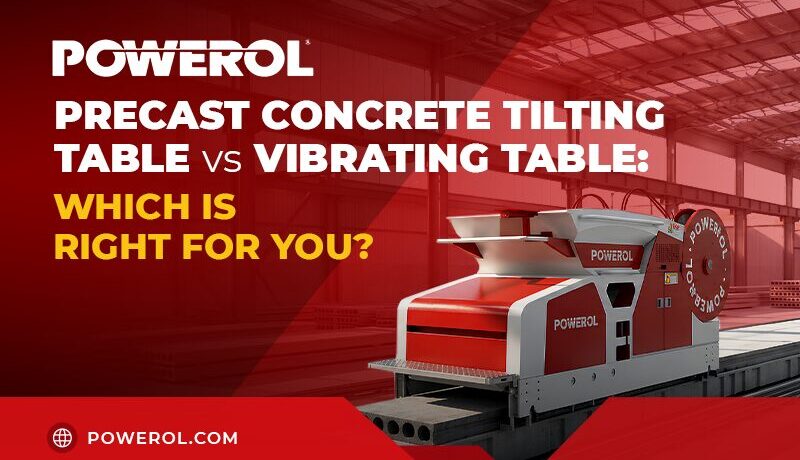
Precast Concrete Tilting Table vs Vibrating Table: Which Is Right for You?
Precast concrete tilting table and precast concrete vibrating table are two core machines in any modern precast concrete plant, but they solve different problems in your production line. Choosing between them (or deciding to use both) depends on your product mix, quality targets, automation level, and long-term expansion plans.
Below is a detailed comparison tailored for Indian precast plant owners, boundary wall manufacturers, and procurement heads evaluating machinery vendors.
Precast Concrete Tilting Table: What It Is and When You Need It
A precast concrete tilting table is a large, steel casting table that stays horizontal during concreting and vibration, and then hydraulically tilts up (often 60–90°) to safely lift and demould large wall panels or slabs.
In simple terms:
It is the core precast wall panel machinery used to cast smooth, dimensionally accurate vertical elements (wall panels, façade panels, solid slabs), then tilt them for easy lifting without damaging edges or corners.
Once concrete is poured and compacted (via integrated vibration or external vibrators), the tilting table stays flat until the element reaches the required lifting strength. Then the table is tilted using hydraulic cylinders, allowing the crane or gantry to pick up the panel in an almost vertical position – ideal for tall wall panels and heavy boundary wall elements.
Key functions and benefits of a precast concrete tilting table:
- Provides a perfectly flat, steel surface for high-quality finishes on one face.
- Ensures dimensional accuracy for wall panels, door/window openings, electrical conduits, and recesses.
- Tilting action makes demoulding safer and faster , especially for large wall and façade elements.
- Can be combined with vibration compaction system precast technology for excellent concrete consolidation.
- Ideal backbone of a precast concrete production line focused on structural and architectural wall elements.
For Indian projects driven by PMAY affordable housing, Smart Cities Mission, and MoRTH’s push for faster, durable infrastructure, tilting tables help standardize high-quality precast wall panels suitable for mass housing, industrial estates, and commercial buildings in states like Tamil Nadu, Andhra Pradesh, Maharashtra, Gujarat, Rajasthan, Telangana, and Karnataka.
Precast Concrete Vibrating Table: What It Is and When You Need It
A precast concrete vibrating table is a heavy-duty steel platform mounted on springs or elastomer pads and powered by vibrators. Moulds or precast forms are placed on the table, and vibration is applied from below to compact concrete.
In simple terms:
It is a universal vibration compaction system used to remove air voids, improve density, and enhance surface finish for a wide variety of precast elements made in moulds.
Instead of being a “casting surface” itself (like a tilting table), the vibrating table is a vibration station . Multiple moulds – for compound walls, columns, beams, small slabs, kerbs, or special elements – are placed on the platform, and vibration compacts the concrete efficiently.
Key functions and benefits of a precast concrete vibrating table:
- Provides strong, controlled vibration to improve compaction , strength, and durability.
- Can handle multiple mould types : boundary wall posts, planks, columns, beams, small panels, steps, and customized precast moulds.
- Particularly valuable for precast boundary wall plants , where many repetitive moulds run in parallel.
- Improves surface finish and reduces honeycombing, leading to fewer rejections and better aesthetics.
- Works well with both manual and semi-automated precast concrete production lines .
For Indian contractors and precast entrepreneurs serving compound wall and boundary wall demand in residential townships, industrial estates, logistics parks, and highway noise barriers, a well-designed vibrating table reduces labour dependence and ensures consistent quality across high-volume production.
Tilting Table vs Vibrating Table: Key Differences at a Glance
The precast concrete tilting table is primarily a casting and demoulding system for large panels and slabs , while the precast concrete vibrating table is a vibration compaction platform for mould-based elements . They are not direct substitutes; they serve overlapping but distinct roles in a precast plant.
Here is a clear comparison:
| Aspect | Precast Concrete Tilting Table | Precast Concrete Vibrating Table |
| Primary role | Casting and tilting of large wall panels/slabs | Vibration compaction of moulded elements |
| Product focus | Wall panels, façade panels, solid slabs, sometimes large boundary wall panels | Boundary wall posts & planks, columns, beams, small slabs, kerbs, custom elements |
| Working principle | Concrete cast on flat steel surface; after curing, hydraulically tilted for demoulding | Moulds placed on vibrating platform; vibration from below compacts concrete |
| Finish quality | Superior flatness and surface finish on one main face | Very good finish depending on mould quality and vibration settings |
| Typical plant type | Integrated precast housing/industrial building plants | Precast boundary wall plant, multiproduct precast units |
| Space requirement | Larger footprint per table, but scalable with carousel or multiple tables | Compact footprint for the vibration station; capacity depends on mould count |
| Investment level | Higher initial investment, especially for large sizes and advanced features | Generally lower to moderate investment, scalable with additional tables |
| Best for | High-volume wall panel production, architectural panels, structural panels | Mass production of repetitive mould-based products (compound walls, columns, etc.) |
Which machine is “better”?
Neither is universally “better”. If your main product is large precast wall panels for buildings , the precast concrete tilting table is the central machine. If your focus is precast boundary wall plant production, a precast concrete vibrating table is usually the first essential machine. Many mature plants use both .
Unsure whether a precast concrete tilting table or vibrating table is the right fit for your plant? Powerol’s experts can help you identify the most efficient solution based on your production requirements and growth plans.
Which Machine Suits Which Precast Product?
Use the precast concrete tilting table for large wall panels and slabs where flatness and vertical handling are critical; use the precast concrete vibrating table for mould-based products such as boundary wall posts, planks, columns, and smaller elements.
Now, let’s match typical Indian precast products to the right machinery.
- Wall panels (structural and non-structural)
For housing (PMAY projects), commercial buildings, and industrial sheds, wall panels demand high dimensional accuracy and repeatable quality.
- Best choice: Precast concrete tilting table
- Why:
- Cast panels on a precise, level style surface.precast mould table India
- Integrate edge formwork, openings, electrical conduits, and lifting anchors easily.
- Tilting makes handling tall panels safer and faster.
- Role of vibrating table:
- Supports production of that complement wall panel production.columns, beams, lintels, stair elements
- Boundary walls and compound walls
India’s demand for compound wall and boundary wall systems is rising rapidly around industrial estates, residential townships, warehouses, and along corridors influenced by MoRTH highway expansions.
- Best choice for a pure boundary wall plant: Precast concrete vibrating table
- Multiple moulds for posts and planks run on a common vibration platform.
- Fast cycle times and consistent compaction.
- Where tilting tables fit:
- When boundary walls are made as (e.g., industrial compound walls, highway noise barriers with bigger panels), a tilting table can be used to cast larger elements.large panel systems
- Slabs
Slabs can be solid, hollow-core, or ribbed.
- Solid slabs / solid floor elements:
- works well for casting, especially in building precast plants.Tilting table
- Hollow core slabs:
- Typically produced by a dedicated on long production beds.hollow core slab machine
- Vibrating tables may be used for smaller slab-based elements or custom designs, but hollow-core is usually a specialized line.
- Columns and beams
- For standard repetitive sections (industrial estates, parking structures, flyover-supporting buildings):
- + moulds is usually more efficient.Vibrating table
- For special architectural or heavy bespoke elements:
- Tilting tables can be adapted with suitable side forms, but this is less common compared to mould-based production.
- Special elements and custom precast products
Street furniture, architectural features, noise barriers, parapets, and custom precast units for Smart Cities Mission often benefit from:
- Vibrating table: When produced in dedicated moulds.
- Tilting table: When these elements are integrated into larger wall or façade panels.
In practice, many plants evolving from precast boundary wall plant operations into full building systems start with a precast concrete vibrating table and then upgrade to precast concrete tilting tables as their product range and project profile expand.
What to Look for When Buying Precast Concrete Machinery in India
Evaluate machine rigidity, vibration quality, hydraulic system reliability, steel surface flatness, after-sales support, and spare parts availability . Also ensure your precast machinery manufacturer India understands local standards, MoRTH, PMAY requirements, and typical Indian operating conditions.
When comparing vendors and offers, move beyond just the price tag and ask the right questions.
- Machine design and build quality
For both a precast concrete tilting table and a precast concrete vibrating table , check:
- Steel thickness, structural ribs, and stiffness of the table surface.
- Quality and sealing of welds to prevent long-term cracks, water ingress, or rust.
- Accuracy of table flatness (critical for tilting tables).
- Robustness of vibration foundations and isolation system (critical for vibrating tables).
- Vibration compaction performance
For vibration-based equipment, insist on a properly engineered vibration compaction system precast :
- Adequate vibration force (kN), frequency, and amplitude for your product types.
- Uniform distribution of vibration across the entire table surface.
- Ability to control vibration intensity and duration for different moulds and mixes.
- Proper isolation to prevent vibration damaging the factory structure or neighbouring equipment.
- Hydraulics and tilting mechanism (for tilting tables)
Ask about:
- Rated tilting angle and maximum load capacity (in tonnes).
- Type and quality of hydraulic cylinders and power pack.
- Safety mechanisms: check valves, emergency stop, mechanical locking, etc.
- Smoothness of motion to avoid shock loads on panels during tilting.
- Installation, training, and commissioning
Many precast plant buyers in India worry about installation complexity and operator training. Clarify:
- Is on-site installation and alignment included?
- Is there training for operators, maintenance staff, and production engineers?
- Are standard operating manuals and maintenance schedules provided in clear, simple language?
- How long does a typical installation and commissioning phase take?
- Maintenance costs and spare parts
To avoid downtime:
- Confirm availability of critical spares (vibrators, hydraulic seals, bearings, control components) within India.
- Check whether the precast machinery manufacturer India has service teams covering your state (Tamil Nadu, Andhra Pradesh, Maharashtra, Gujarat, Rajasthan, Telangana, Karnataka, etc.).
- Ask for preventive maintenance guidelines and recommended service intervals.
- Compatibility with your precast concrete production line
If you already have moulds or plan to add hollow core slab machines , carousel lines, or other precast concrete wall panel machinery , make sure:
- Table sizes and load capacities match your current and future product plans.
- Controls and electrical systems can integrate with your plant’s automation or batching systems.
- Expansion possibilities exist – for example, adding more tilting tables or vibrating tables as demand grows.
Can One Machine Replace the Other – Or Do You Need Both?
In a small, focused precast boundary wall plant , a powerful precast concrete vibrating table can handle most products. In a full building precast plant, a precast concrete tilting table is essential. As your plant grows, many producers use both machines to optimize different product lines.
When vibrating table alone is enough:
- Core product: boundary wall posts & planks, compound wall elements, small slabs, columns, beams.
- Market focus: local residential and industrial compounds, small industrial estates, perimeter fencing.
- Investment level: starting or medium-scale enterprise building volume and brand.
When tilting table becomes essential:
- Products: large structural wall panels, façade panels, large slab panels, noise barrier panels for highways.
- Market: PMAY housing projects, Smart Cities building projects, technology parks, grade-A industrial estates.
- Need for: high flatness, dimensional accuracy, architectural surface quality.
When using both makes strategic sense:
- Plants aiming to serve both compound wall demand and building / infrastructure projects .
- Producers in fast-growing states like Maharashtra, Gujarat, Tamil Nadu, and Telangana who want to move up the value chain from simple boundary walls to full precast building systems.
- Export-oriented units catering to overseas buyers who expect flexible product portfolios and consistent quality.
A well-designed precast concrete production line often evolves in phases. Starting with a versatile precast concrete vibrating table for mould-based elements, and later adding one or more precast concrete tilting tables to scale into wall panels, is a proven path for Indian producers.
How Much Does a Precast Tilting Table Cost in India?
In India, a precast concrete tilting table typically represents a mid– to high-value capital investment, influenced by table size, load capacity, level of automation, and integrated vibration features. Costs vary widely, so serious buyers should request a tailored quotation based on product size, daily output targets, and plant layout.
Rather than chasing a single “standard price”, consider:
- Table size: Larger tables that accommodate big wall panels or slabs require more steel, stronger hydraulics, and heavier structure.
- Load capacity: Tables designed for heavier elements or dense reinforcement need stronger support and hydraulic systems.
- Vibration integration: Tilting tables with built-in vibration compaction system precast will cost more than basic, non-vibrating tables.
- Automation: Options such as automatic tilting sequences, advanced control panels, and integration with circulation systems increase investment but improve efficiency and safety.
- Customization: Special edge profiles, integrated magnetic shuttering systems, or architectural surface solutions add value and cost.
For a realistic budget and lifecycle costing, it is better to share your specific requirements – target daily production, element sizes, product mix – with an experienced precast machinery manufacturer India and obtain a project-specific proposal rather than relying on generic price ranges.
Powerol: Indian Precast Machinery Manufacturer for Both Tilting and Vibrating Tables
If you want a single partner who understands Indian site realities, government program timelines, and international quality expectations and who can supply both a precast concrete tilting table and a precast concrete vibrating table – Powerol is positioned as that partner.
Powerol is a trailblazer in the Indian construction machinery industry , combining ground‑breaking technology with robust, reliable precast concrete machinery suited to Indian conditions and global standards. With manufacturing facilities in key industrial regions of India and a portfolio that spans concrete and asphalt construction equipment, Powerol supports:
- Precast boundary wall plants supplying residential, industrial, and highway projects.
- Integrated precast concrete production lines for housing, industrial parks, and Smart Cities Mission projects.
- Clients across India and overseas who require proven performance, reliable service support, and long-term partnerships.
By offering both precast wall panel machinery (tilting tables, mould tables, and associated systems) and vibration-based solutions (vibrating tables, vibration compaction systems, and related equipment), Powerol allows plant owners to:
- Start with a focused boundary wall setup and later expand into structural precast.
- Design a balanced production line that uses each machine where it delivers the best ROI.
- Count on pan‑India service, spares availability, and training support.
FAQs
- What is a precast concrete tilting table?
A precast concrete tilting table is a rigid steel casting surface with an integrated hydraulic tilting mechanism. Concrete is poured and finished on the flat table, and once the element gains strength, the table tilts up so that large wall panels or slabs can be safely lifted and removed without damage. - What is a precast concrete vibrating table?
A precast concrete vibrating table is a heavy-duty platform fitted with vibrators and elastic supports. Moulds containing concrete are placed on it, and vibration from the table compacts the mix, removes air voids, and improves surface finish and strength across a wide variety of precast elements. - What is the difference between a tilting table and vibrating table?
A tilting table is primarily a casting and demoulding surface for panels , while a vibrating table is a universal compaction platform for moulds . Tilting tables are ideal for large wall and façade panels; vibrating tables are ideal for posts, planks, columns, beams, and small slabs. - Which precast machine is better for wall panels?
For large structural or façade wall panels used in PMAY housing, Smart Cities buildings, and industrial projects, a precast concrete tilting table is typically the better choice, offering better flatness, dimensional accuracy, and safe demoulding. - Which machine is used in a precast boundary wall plant?
Most precast boundary wall plants in India rely primarily on a precast concrete vibrating table . Multiple moulds for posts and panels are vibrated together, making the process efficient, scalable, and suitable for high-volume compound wall production. - What precast concrete machinery do I need for my production line?
The ideal precast concrete production line depends on your product mix. For boundary wall–only plants, start with a precast concrete vibrating table and appropriate moulds. For wall panel and slab plants, add one or more precast concrete tilting tables and compatible formwork. As you grow, you may integrate specialized machines like a hollow core slab machine and additional finishing or handling equipment. - Can a precast plant use both a tilting table and vibrating table?
Yes. Many progressive plants in Tamil Nadu, Maharashtra, Gujarat, Telangana, and other precast hubs use both . Vibrating tables handle repetitive mould-based elements, while tilting tables produce structural wall panels and large slabs. This combination maximizes product range and plant utilization. - Are Indian-made precast machines suitable for overseas projects?
A proven precast machinery manufacturer India with global clients – like Powerol – designs equipment to meet demanding performance, durability, and safety standards. With proper engineering, quality control, and after-sales support, Indian-made precast mould tables and vibrating tables can perform reliably in overseas markets as well.
If you are currently comparing a precast concrete tilting table vs a precast concrete vibrating table for your boundary wall plant or precast production line, the most effective next step is to discuss your product mix, target states, and project pipeline with an expert manufacturer. Powerol designs and builds both machine types, tailors them to Indian and international project requirements, and supports you from layout planning to commissioning.
To choose the right combination of precast concrete tilting table and precast concrete vibrating table for your plant, reach out to Powerol’s team today to discuss your project and request a detailed machinery proposal.