
- Your cart is empty Browse Shop
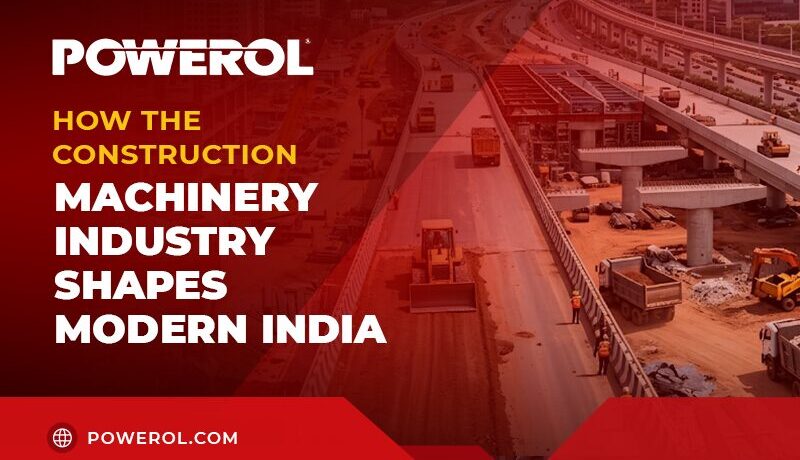
How the Construction Machinery Industry Shapes Modern India
India’s construction machinery industry is at the centre of the country’s biggest infrastructure transformation in history. From metro rails and expressways to affordable housing and smart cities, nothing moves without the construction machinery industry powering it in the background. Yet for many buyers, investors, and developers, it is still unclear how this industry connects to their specific machinery decisions.
This blog demystifies India’s construction machinery landscape and shows how modern India is being built by three high-impact segments: precast concrete technology , AAC block plants , and concrete recycling systems all areas where Powerol offers full-range, made-in-India solutions.
What is the construction machinery industry in India?
The construction machinery industry in India comprises all equipment used to plan, build, and maintain infrastructure and buildings from concrete batching and precast plants to AAC block manufacturing machines, concrete recycling plants, road equipment, and material handling systems. It forms the backbone of India’s real estate, roads, rail, urban infrastructure, and industrial projects.
In practical terms, this industry enables developers, EPC contractors, and government agencies to execute projects faster, safer, and at scale. For companies like Powerol, this means designing and manufacturing machinery that converts cement, aggregates, and waste into high-performance building components serving everything from high-rise housing to industrial parks.
How big is India’s construction machinery market?
India’s construction machinery market has grown into a multi-INR lakh-crore opportunity, fuelled by sustained public and private investment in infrastructure and housing. Over the last decade, India has consistently ranked among the fastest-growing construction markets globally, with machinery demand closely tracking this growth.
Several forces drive this expansion:
- Government infrastructure pipeline under the National Infrastructure Pipeline (NIP) of ₹111 lakh crore over multiple years.
- Massive urbanisation, with millions migrating to cities, creating demand for housing, commercial, and civic infrastructure.
- Focus on affordable housing , industrial corridors, and logistics parks under schemes like PMAY and PM Gati Shakti .
- Increasing adoption of precast and AAC technologies to reduce construction time and lifecycle costs.
For buyers, this market scale translates into one key insight: India’s construction machinery industry is not a niche, it is a long-term growth platform. Strategic investment in the right machinery segment today can generate returns for decades, especially when aligned with policy and urbanisation trends.
Major segments of India’s construction machinery industry
At a high level, India’s construction machinery ecosystem can be viewed in three layers:
- Core building systems – such as precast concrete technology , AAC block plants , and ready-mix concrete systems.
- Project execution machinery – such as pavers, asphalt plants, road-building machinery, and cranes.
- Sustainability and lifecycle machinery – including concrete recycling machines , demolition waste processing, and C&D recycling plants.
Powerol focuses on the most structural impact areas in this stack: precast plants , AAC block manufacturing machines , and concrete recycling plants that directly determine speed, cost, quality, and sustainability of modern Indian construction.
Across active states like Tamil Nadu, Andhra Pradesh, Maharashtra, Gujarat, Rajasthan, Karnataka, Delhi NCR, and Telangana , these machinery segments are rapidly becoming default choices for forward-looking developers and infrastructure players.
Segment 1: Precast concrete technology and India’s precast landscape
Precast concrete technology uses factory-made, standardised concrete elements such as columns, beams, slabs, wall panels, and staircases that are manufactured in a precast plant and then transported to site for assembly. This shifts much of the construction from an open, weather-dependent site to a controlled industrial environment.
In India, precast concrete is increasingly used in:
- High-rise residential and commercial towers
- Metro and rail infrastructure
- Industrial and logistics parks
- Multi-level car parks and institutional buildings
For developers and contractors, precast technology offers:
- Speed – Faster project cycles compared to conventional cast-in-situ methods.
- Quality – Factory-controlled production with consistent strength and finish.
- Safety & labour efficiency – Reduced site congestion and dependence on scarce skilled labour.
- Predictability – Clearer timelines and reduced rework.
Powerol’s role among precast machinery manufacturers in India
When stakeholders ask, “Who are the top precast machinery manufacturers in India?” they are really looking for three things: technology depth, reliability, and full-range solutions.
Powerol positions itself precisely here by offering:
- Design and engineering of integrated precast plants , from batching and casting to curing and handling.
- Machinery optimized for Indian conditions temperature, raw material variability, labour skill levels, and site logistics.
- Solutions that meet the expectations of Tier-1 developers as well as emerging regional players in states like Maharashtra, Gujarat, Tamil Nadu, and Telangana .
Where many buyers feel lost between generic equipment suppliers and imported solutions, Powerol acts as a technology partner , connecting macro precast adoption trends directly to practical plant layouts, machinery selection, and ROI.
Segment 2: AAC block manufacturing machines and AAC block plants – the affordable housing engine
An AAC block manufacturing machine converts a mixture of cement, lime, fly ash, and aluminium powder into lightweight, aerated concrete blocks. These blocks are produced in an AAC block plant that handles batching, mixing, pouring, cutting, autoclaving, and packaging.
AAC (Autoclaved Aerated Concrete) has become central to India’s affordable housing and mid-segment real estate growth because it offers:
- Lightweight construction – reducing dead loads on foundations and structures.
- Thermal insulation – improving energy efficiency and comfort in hot climates.
- Faster masonry – larger block sizes and easier handling.
- Use of industrial by-products – enabling more sustainable construction.
Under schemes like Pradhan Mantri Awas Yojana (PMAY) and Smart Cities Mission , the emphasis is on speed, performance, and resource efficiency. AAC fits this perfectly, and demand for AAC block plants has surged in states like Andhra Pradesh, Telangana, Rajasthan, Gujarat, and Karnataka .
How Powerol connects AAC machinery to the bigger industry picture?
Many first-time investors and entrepreneurs ask:
- Should I enter the AAC block business?
- How does AAC fit within India’s broader construction machinery industry?
- Will demand sustain beyond government schemes?
Powerol helps answer these by:
- Positioning AAC as a structural part of India’s housing and urban growth story , not a passing trend.
- Designing AAC block plants that are right-sized for regional demand, power availability, and logistics.
- Guiding investors on plant capacity, automation levels, and downstream customer segments (developers, contractors, government projects).
By offering end-to-end AAC block manufacturing machine solutions, Powerol enables stakeholders to plug directly into the most active construction markets without having to decipher the entire ecosystem alone.
Segment 3: Concrete recycling machines and plants – turning waste into opportunity
A concrete recycling machine processes demolition debris and returned concrete into usable aggregates and materials. When integrated into a concrete recycling plant , it allows contractors, cities, and infrastructure players to:
- Reduce landfill pressure and dumping costs
- Recover aggregates for non-structural applications
- Comply with environmental regulations and tender conditions
- Improve ESG performance and sustainability markers
India’s construction and demolition (C&D) waste is rising sharply, especially in high-growth regions like Delhi NCR, Maharashtra, Tamil Nadu, and Karnataka . The upcoming C&D Waste Rules 2025 and urban local body regulations are making waste recycling a compliance necessity, not just a “green initiative”.
Powerol’s concrete recycling solutions for a sustainable construction machinery industry
For buyers confused about where sustainability fits into machinery investment, Powerol’s concrete recycling machines and plants provide a clear entry point:
- On-site or near-site recycling for large infrastructure projects.
- Tailored solutions for metro, road, and urban redevelopment projects under schemes like Bharatmala , Sagarmala , and Smart Cities Mission .
- Integration with batching and precast operations to create circular material loops.
Instead of treating waste as a problem, Powerol’s machinery converts it into a profitable raw material stream , aligning investors and contractors with both environmental norms and cost savings.
How the construction machinery industry powers India’s development?
The construction machinery industry contributes to India’s development in three interconnected ways:
- Infrastructure capacity – Modern machinery makes it possible to build expressways, airports, ports, metros, and industrial corridors faster and at scale, supporting economic growth and jobs.
- Urbanisation quality – Technologies like precast concrete technology and AAC block plants improve building performance, safety, and liveability.
- Sustainability and compliance – Concrete recycling plants help India meet environmental commitments and resource efficiency goals.
In states like Gujarat and Maharashtra , efficient logistics and industrial ecosystems amplify the impact of machinery investments. In Tamil Nadu, Karnataka, and Telangana , strong manufacturing and IT sectors demand high-quality commercial and residential infrastructure, again relying on advanced construction machinery systems.
For policymakers, the industry acts as a force multiplier : every rupee invested in machinery can unlock many times more value in completed infrastructure assets.
Government schemes driving India’s construction machinery industry
India’s policy framework is tightly linked to machinery demand. Some of the most influential schemes include:
- PM Gati Shakti – an integrated infrastructure masterplan that coordinates roads, railways, ports, logistics, and industrial corridors, driving sustained machinery demand.
- National Infrastructure Pipeline (NIP) – ₹111 lakh crore – a long-term project pipeline providing visibility and confidence for machinery investments.
- PMAY (Pradhan Mantri Awas Yojana) – accelerating affordable housing, increasing need for AAC block plants and high-speed construction technologies.
- Smart Cities Mission – pushing integrated urban infrastructure, favouring precast and modular solutions.
- Bharatmala & Sagarmala – highway and port-led development, creating material demand and waste streams that benefit from concrete recycling machines .
- MoRTH precast mandate – encouraging precast use in national highway and bridge projects, directly boosting precast concrete technology adoption.
- Make in India – promoting domestic manufacturing of construction machinery, benefiting companies like Powerol with strong engineering and manufacturing bases in India.
Instead of trying to decode each scheme in isolation, buyers can see a simple pattern: every major government initiative points to higher demand for fast, industrialised, and sustainable construction machinery.
How automation and Make in India are transforming construction machinery?
India’s construction machinery industry is moving from manual, site-dependent methods to automated, plant-driven, and digitally enabled systems .
Automation is changing the sector through:
- Automated batching, mixing, and curing in precast and AAC plants – improving consistency and cutting wastage.
- Integrated control systems that monitor production, energy use, and maintenance.
- Optimised plant layouts that reduce manual handling and improve throughput.
The Make in India initiative amplifies this shift by:
- Encouraging global technology localisation in India.
- Supporting manufacturing clusters in states like Gujarat, Maharashtra, Tamil Nadu, and Andhra Pradesh .
- Giving Indian manufacturers like Powerol the scale and ecosystem to compete globally.
For overseas buyers evaluating India, this means:
- Access to global-standard construction machinery with INR cost structures and local support.
- Confidence that Indian machinery is aligned with international quality expectations yet tuned to emerging market realities.
Powerol, with its focus on precast plants , AAC block manufacturing machines , and concrete recycling plants , embodies this automation-plus-Make-in-India evolution bringing advanced technology within reach of both domestic and international customers.
What this means for buyers, investors, and developers in 2026?
By 2026, the choice is no longer between “traditional” and “modern” construction. The real choice is between:
- Being on the demand side of India’s infrastructure boom only as a contractor or developer, or
- Being on the asset side by owning high-value machinery that powers this boom.
For contractors, developers, and procurement heads:
- Precast concrete technology enables faster, more predictable project delivery.
- AAC block plants align you with housing and mid-segment building demand.
- Concrete recycling machines future-proof your operations against regulatory and ESG risks.
For investors and entrepreneurs:
- Each machinery segment connects to a clear, identifiable demand driver from PMAY to Smart Cities to C&D Waste Rules 2025.
- Partnering with a full-range manufacturer like Powerol reduces entry risk by consolidating engineering, commissioning, and lifecycle support under one roof.
For overseas buyers:
- India’s is no longer just a low-cost alternative; it is increasingly a with strong domestic demand and improving global credentials.construction machinery industrytechnology-driven manufacturing hub
FAQs
- What is the construction machinery industry in India?
It is the ecosystem of equipment and plants such as precast, AAC, concrete recycling, asphalt, and concrete batching used to build infrastructure and buildings across India’s public and private sectors. - How does the construction machinery industry contribute to India’s development?
It accelerates infrastructure delivery, improves construction quality and safety, and enables sustainable practices like material recycling, directly supporting GDP growth, urbanisation, and environmental goals. - What is precast concrete technology and how is it used in India?
Precast concrete technology produces structural and non-structural elements in a plant and assembles them on site. In India it is used for metro systems, bridges, high-rise housing, industrial buildings, and parking structures, especially under MoRTH, Smart Cities, and NIP-linked projects. - What is an AAC block manufacturing machine?
An AAC block manufacturing machine is part of an integrated AAC block plant that mixes and processes raw materials into lightweight aerated concrete blocks through casting, cutting, and autoclaving, supplying high-performance masonry units to the building sector. - What is a concrete recycling machine?
A concrete recycling machine processes demolition debris and returned concrete into reusable aggregates or materials. When built into a concrete recycling plant, it supports circular construction, cost savings, and compliance with regulations like the C&D Waste Rules 2025. - Who are the top precast machinery manufacturers in India?
Top precast machinery manufacturers in India are those that offer turnkey plant engineering, Indian-conditions design, and lifecycle support. Powerol is positioned in this space, supplying integrated precast plant solutions and equipment to developers and infrastructure players. - How big is India’s construction machinery market?
The market is a multi-INR lakh-crore segment tied to the NIP’s ₹111 lakh crore infrastructure pipeline, PMAY housing targets, and ongoing urban and industrial growth, making it one of the most promising machinery markets globally. - What government policies are driving construction machinery demand?
Key policies include PM Gati Shakti , NIP (₹111 lakh crore) , PMAY , Smart Cities Mission , Bharatmala , Sagarmala , MoRTH precast mandates , C&D Waste Rules 2025 , and Make in India , all of which directly or indirectly stimulate precast, AAC, and recycling machinery adoption.
Your next step in India’s construction machinery industry
India’s construction machinery industry is no longer a background sector, it is the operational engine of the country’s infrastructure and urban transformation. Whether your entry point is precast concrete technology , an AAC block plant , or a concrete recycling machine , choosing the right partner determines your real returns.
Powerol brings all three segments under one made-in-India, globally aligned umbrella, with manufacturing presence and project footprints across Tamil Nadu, Andhra Pradesh, Maharashtra, Gujarat, Rajasthan, Karnataka, Delhi NCR, and Telangana .
If you are a contractor, developer, investor, or procurement head looking to understand where to start and how each machinery choice fits into the bigger picture of India’s growth now is the time to act. Connect with Powerol to design the right machinery roadmap for your business and build your stake in India’s construction machinery industry for the next decade and beyond.