


- Your cart is empty Browse Shop
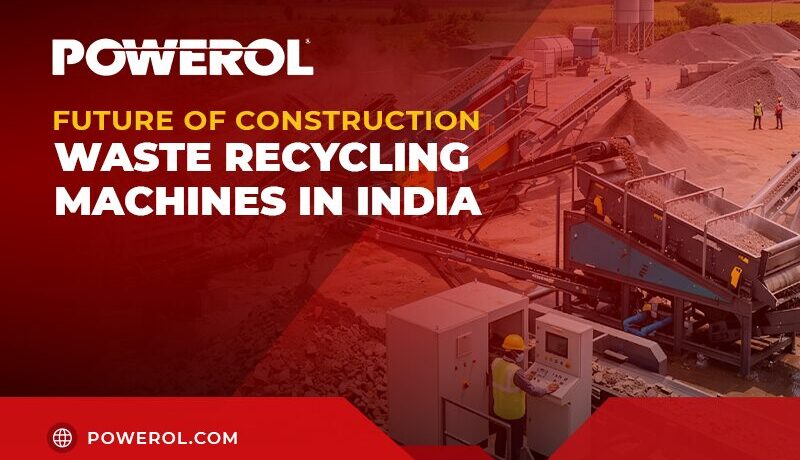
Future of Construction Waste Recycling Machines in India
India generates up to 500 million tonnes of construction and demolition (C&D) waste every year and from April 1, 2026, new rules will make construction waste recycling non‑negotiable. For contractors, plant investors, and infrastructure developers, the question is no longer if they should adopt construction waste recycling machines , but how fast they can move and which partner will help them stay ahead.
This blog explains what these machines are, where India’s market is headed, how regulations will change your business, and why choosing a future‑ready manufacturer like Powerol now can lock in a strategic edge.
What is a construction waste recycling machine?
A construction waste recycling machine is specialized equipment that processes concrete, asphalt, bricks, and other C&D debris into reusable materials like recycled aggregates, sand, and reclaimed concrete. In simple terms, these machines turn what you currently pay to dump into products you can reuse or sell.
A full setup usually includes crushers, screens, washing systems, conveyors, and a concrete recycling system or complete concrete waste recycling plant that separates, cleans, and grades the material so it meets engineering and BIS standards for reuse.
The future of construction waste recycling in India: Why it’s not “too early” anymore
The future of construction waste recycling in India is being shaped by three unstoppable forces: regulation, land scarcity, and project economics. Together, they are making construction waste recycling machines a core part of how projects are planned and executed, not a nice‑to‑have add‑on.
In leading C&D waste states like Delhi, Maharashtra, Tamil Nadu, Karnataka, Gujarat, Rajasthan, Andhra Pradesh, and Telangana , urban bodies and infrastructure agencies are already shifting tenders and contracts to favour projects with on‑site or nearby C&D waste recycling plants in India . For contractors and investors, waiting on the sidelines now carries more risk than getting in early with the right technology and partner.
Where India’s construction waste recycling market stands today
India is estimated to generate 150–500 million tonnes of C&D waste annually , yet only a fraction is scientifically processed through organized recycling plants. Most still ends up in landfills, along highways, or dumped in low‑lying areas, all of which will increasingly attract penalties and compliance notices.
Today’s market is defined by three gaps, which also represent opportunity:
- Regulation–implementation gap: Rules are tightening, but capacity is still catching up. This is why early movers in setting up concrete waste recycling plants are securing long‑term contracts and tipping fee arrangements from municipalities and infrastructure agencies.
- Technology–awareness gap: Many contractors do not clearly understand the difference between a concrete recycling system attached to a concrete plant and a complete construction demolition waste machinery setup designed for mixed C&D waste. This confusion delays decisions and creates fear of investing in the “wrong” assets.
- Domestic–global capability gap perception: Overseas buyers and EPC players still question whether concrete recycling equipment in India can match European or American standards. In reality, Indian manufacturers like Powerol are now building plants that are export‑ready, scalable, and engineered for harsh duty cycles and variable waste composition.
The market is at an inflection point: capacity, regulation, and demand are aligning. Players who build or upgrade plants between now and 2026 are likely to become the reference operators others follow.
Government regulations driving the future: C&D Rules 2025 and beyond
From a regulatory standpoint, the Construction and Demolition Waste Management Rules 2025 — effective April 1, 2026 — are the single biggest driver of the future for construction waste recycling machines in India.
In practical terms, here is what you need to understand:
- First, urban local bodies, smart cities, and state pollution control boards will be under pressure to ensure that a significant percentage of C&D waste is processed through authorized facilities rather than dumped. This will create strong demand for C&D waste recycling plants in India and for private operators who can build, own, and operate them.
- Second, developers and large contractors will begin to see Extended Producer Responsibility (EPR) style clauses in contracts, making them responsible for how their construction waste is handled. You will increasingly need access to a concrete waste recycling plant or tie‑ups with operators who own one.
- Third, BIS standards for recycled aggregates and recycled concrete materials will gradually be referenced in codes and specifications, giving confidence to use recycled material in non‑structural and, over time, more critical applications. This directly boosts the business case for investing in recycled aggregate machinery in India .
For anyone still unsure whether this is a passing trend, the direction is clear: from 2026 onwards, non‑compliance will directly hit eligibility for projects, clearances, and approvals.
Future Trend 1: Automation entering construction waste recycling machines
Automation will be the biggest safeguard against your machinery becoming obsolete in 2–3 years.
In the coming decade, construction waste recycling machines will increasingly feature:
- First, automated material handling and sorting, where conveyors, feeders, and screens adjust based on throughput and material type. This stabilizes output quality and reduces the dependency on highly skilled operators.
- Second, sensor‑based monitoring for moisture, particle size, contamination, and equipment health. Integrated PLCs and SCADA systems in a modern concrete recycling system will help operators maintain consistent production even when input waste is highly variable.
- Third, automated washing, silt removal, and water recycling loops that reduce freshwater consumption — a critical factor in water‑stressed states like Rajasthan, Gujarat, and parts of Tamil Nadu.
For plant investors, automation does three things: it lowers operating cost per tonne, improves product consistency, and makes compliance reporting easier. When evaluating a concrete recycling plant manufacturer , the question is no longer just “What capacity?” but “How automated is your plant, and how easily can it be upgraded?”
Future Trend 2: Mobile concrete recycling plants for on‑site use
The difference between a mobile and fixed concrete recycling plant will sharply influence project strategy for highways, metro corridors, industrial parks, and large townships.
A fixed plant is typically located at a permanent site, often serving an entire city or region. It is ideal for continuous, high‑volume operations and for public–private partnership (PPP) models where waste is brought in from multiple projects.
A mobile concrete recycling plant, by contrast, is mounted on skids or semi‑mobile structures, and designed to move closer to the job site. For large linear infrastructure in states like Maharashtra, Karnataka, Andhra Pradesh, Rajasthan, and Gujarat , mobile plants offer three major advantages: dramatically reduced haulage cost and time, easier compliance with project‑specific environmental conditions, and the ability to reuse recycled aggregates directly in pavement layers, non‑structural concrete, and backfilling.
As tender conditions start asking for on‑site construction waste recycling machines as part of the contractor’s deployment plan, mobile solutions will shift from an experiment to a competitive necessity. Powerol’s expertise in heavy‑duty concrete plants and related machinery positions it well to engineer mobile recycling setups that match Indian site realities.
Future Trend 3: AI and digital monitoring in concrete recycling systems
The next wave in construction demolition waste machinery will be driven by AI, data, and digital twins, not just steel and motors.
In the near future, BIM (Building Information Modelling) and AI will affect recycling machinery in India in several ways. First, design models of buildings, bridges, and structures will feed predicted waste quantities and material types into project planning. This allows contractors to size and schedule construction waste recycling machines and logistics well before demolition actually begins.
Second, AI‑driven analytics will run on plant SCADA data, including production rates, downtime patterns, energy consumption, and product gradation to recommend optimal operating parameters, maintenance schedules, and even shift‑wise staffing. This is how concrete recycling equipment in India will evolve from manual, trial‑and‑error operations to predictable, data‑driven plants.
Third, real‑time dashboards accessible to project owners, EPCs, and regulatory bodies will provide transparent traceability of how much C&D waste was generated, processed, and reused. Over time, this transparency will be linked to green ratings, incentives, and faster approvals.
Investors worried about “buying a machine that gets outdated” should instead ask: Is my chosen manufacturer building AI‑ready, sensor‑rich, upgradable platforms? Powerol, with its strong control over engineering and manufacturing in India, is ideally placed to offer such future‑proof systems.
Future Trend 4: Recycled aggregate becoming mainstream in Indian construction
A central question for many decision‑makers is: Is construction waste recycling profitable in India? The answer increasingly depends on one factor, the market acceptance of recycled materials.
The trajectory is clear. As more cities enforce the Construction and Demolition Waste Management Rules 2025 — effective April 1, 2026 , and as BIS standards for recycled aggregates are implemented in practice, recycled products will find wide use in: sub‑base and base layers for roads and highways, non‑structural concrete for pavements, drains, and boundary walls, precast blocks, pavers, and kerbs, and backfilling and landscaping works in real estate and industrial projects.
In high‑activity states such as Delhi, Maharashtra, Tamil Nadu, Karnataka, Gujarat, Rajasthan, Andhra Pradesh, and Telangana , this will translate into robust, long‑term demand for output from C&D waste recycling plants in India . As acceptance grows, plants with reliable recycled aggregate machinery in India will not just meet compliance requirements but also create new revenue streams from selling graded materials.
This is why the most successful recycling plants will be those engineered to produce consistent, BIS‑compliant products rather than just “processed waste”.
What this means for your plant investment: When to invest and what to buy
If you are hesitating because you “don’t know if investing in construction waste recycling machines is worth it now or too early,” the timeline of regulations offers a clear answer: the window between now and April 2026 is the advantage window.
Here is a strategic way to think about your investment:
In 2024–2025 (and the immediate run‑up to enforcement), early movers will acquire land, finalize technology partners, and order their plants. This period is ideal for locking in pricing, custom configurations, and delivery slots with a concrete recycling plant manufacturer like Powerol, before demand spikes and lead times lengthen.
From April 1, 2026 onwards, the market will shift to compliance mode. Projects and municipalities will look for ready, operational capacity. Plants commissioned during this phase will still be viable, but will face more competition for contracts and may suffer from longer equipment delivery cycles.
When evaluating construction waste recycling machines , focus on three decision pillars: scope (do you need a concrete recycling system integrated with a concrete plant , or a full concrete waste recycling plant for mixed C&D waste?), scalability (can the plant be expanded from, say, 100–150 TPH to higher capacities as city‑wide contracts grow?), and future readiness (automation, AI, connectivity, and compliance‑ready reporting from day one).
Choosing the right manufacturer is as important as choosing the right machine. Technology, after‑sales support, local parts availability, and the ability to adapt to new standards and digital requirements will determine your plant’s performance over the next 10–15 years.
Powerol — a concrete recycling plant manufacturer ready for India’s future
Powerol has already established itself as a trailblazer in the Indian construction machinery industry , combining robust engineering with advanced controls across concrete and asphalt equipment. Its manufacturing footprint across India enables it to design and deliver heavy‑duty machinery tailored to local site conditions, climate, and usage patterns.
For investors and contractors seeking a long‑term partner, Powerol’s strengths translate directly into better recycling plants: deep concrete and asphalt expertise, which is critical when designing concrete recycling systems that must integrate with batching plants, transit mixers, and paving operations; strong in‑house engineering and fabrication, allowing for custom configurations of construction waste recycling machines for different waste streams and capacities; and a pan‑India presence that supports installations in active C&D waste markets like Delhi, Maharashtra, Tamil Nadu, Karnataka, Gujarat, Rajasthan, Andhra Pradesh, and Telangana , as well as export projects.
Most importantly, Powerol’s forward‑looking approach means its plants are designed for automation, remote monitoring, and future integration with AI‑driven analytics and BIM‑enabled project workflows — exactly the direction in which construction demolition waste machinery is headed globally.
If you are an overseas buyer wondering whether concrete recycling equipment in India can scale with your future needs, Powerol’s global client base and high‑quality manufacturing standards offer a reassuring answer: you can lock in cost‑efficient Indian engineering without compromising on performance, scalability, or durability.
FAQs
- What is a construction waste recycling machine?
A construction waste recycling machine is equipment designed to process C&D waste — such as concrete, bricks, blocks, asphalt, and rubble into reusable materials like recycled aggregates, sand, and reclaimed concrete. It typically includes crushers, screens, washing units, and a concrete recycling system or full plant to clean, grade, and separate the materials for reuse. - What is the future of construction waste recycling in India?
The future is regulation‑driven, technology‑enabled, and highly localized. With India generating 150–500 million tonnes of C&D waste annually and the Construction and Demolition Waste Management Rules 2025, effective April 1, 2026 , recycling will shift from an optional sustainability choice to a mandatory requirement in major states. Plants using modern construction waste recycling machines will become critical infrastructure for cities and large projects. - What are the new government rules for construction waste recycling in India?
The key framework is the Construction and Demolition Waste Management Rules 2025 — effective April 1, 2026 . These rules will push urban local bodies and developers to ensure C&D waste is segregated, collected, and processed through authorized facilities, and will promote the use of recycled materials that meet BIS standards. As these rules are enforced, demand for C&D waste recycling plants in India and compliant machinery will accelerate. - How will automation change construction waste recycling machines?
Automation will make plants far more efficient, predictable, and compliant. Automated feeders and screens will adjust to variable waste streams; sensor‑driven washing and water recycling will optimize resource use; and PLC/SCADA systems will enable precise control and data logging. For owners, this means lower operating costs, higher uptime, and easier proof of compliance — as long as they choose construction waste recycling machines built on modern automation platforms. - What is a concrete recycling system and how does it work?
A concrete recycling system is typically installed alongside a concrete plant to handle leftover concrete, returned concrete from transit mixers, and washout water. It separates solid aggregates from slurry, recovers sand and stone, and recycles the water back into the plant. In more advanced configurations, it forms part of a broader concrete waste recycling plant that processes not just fresh concrete waste but also hardened concrete and demolition debris. - What is the ROI of a concrete waste recycling plant in India?
ROI varies by capacity, location, and business model, but in active markets like Delhi, Maharashtra, Karnataka, Gujarat, and Telangana , well‑designed plants can recover their investment over a medium‑term horizon through tipping fees from municipalities, savings from avoided landfill and transport costs, and revenue from selling recycled aggregates, sand, and products like blocks and pavers. As regulations tighten after 2026 and recycled material acceptance grows, ROI profiles for concrete waste recycling plants are expected to strengthen further. - Who are the concrete recycling plant manufacturers in India?
Several manufacturers offer recycling solutions, but only a few combine deep concrete technology expertise, heavy‑duty engineering, and future‑ready automation. Powerol stands out as a concrete recycling plant manufacturer with strong capabilities in concrete and asphalt machinery, robust Indian manufacturing, and the ability to design customized construction waste recycling machines for both domestic and international markets. - What is the difference between a mobile and fixed concrete recycling plant?
A fixed plant is permanently installed, typically serving an entire city or cluster of projects with steady C&D waste inflows. It suits long‑term concessions and central processing hubs. A mobile concrete recycling plant, on the other hand, is designed for relocation closer to project sites ideal for large linear infrastructure, greenfield townships, or industrial parks. Mobile plants reduce haulage costs and enable on‑site use of recycled aggregates, while fixed plants excel at scale and regional coverage. - How will BIM and AI affect recycling machinery in India?
BIM models will increasingly predict C&D waste quantities and compositions during the design phase, allowing early planning of construction waste recycling machines and logistics. AI will then optimize plant operations in real time from balancing loads across crushers and screens to scheduling preventive maintenance and improving product consistency. Machinery that is digital‑ready, sensor‑equipped, and connected will be better positioned to plug into these workflows and stay relevant. - Is construction waste recycling profitable in India?
Yes, and its profitability is likely to improve over the next decade. Profit drivers include tipping fees, sale of recycled aggregates and sand, reduced transport and disposal costs, and preferential access to government and private projects that value sustainability and compliance. The key is to invest in reliable construction waste recycling machines , engineered by a strong partner like Powerol, and to locate your C&D waste recycling plant in India where waste generation and regulatory enforcement are both high.
If you are evaluating construction waste recycling machines for your next project or investment, now is the time to plan before the April 2026 rules reshape the market. To explore a future‑ready concrete waste recycling plant or discuss a customized concrete recycling system for your projects in India or overseas, connect with Powerol’s team of experts and design a plant that keeps you ahead of regulation, competition, and technology shifts.